
Persimmons
our place was under the persimmons.
shaded from grownup cares.
running, hiding, seeking,
laughing together. sharing dreams.

Our Animals
Today, there are two donkeys instead of several dozen in this village of five hundred people. Together with the swimming pool filled with water from Cyprus’ new desalinization plant, this stocky brown animal decorates the gardens of a household whose head made a lot of money as a restaurant owner in America.
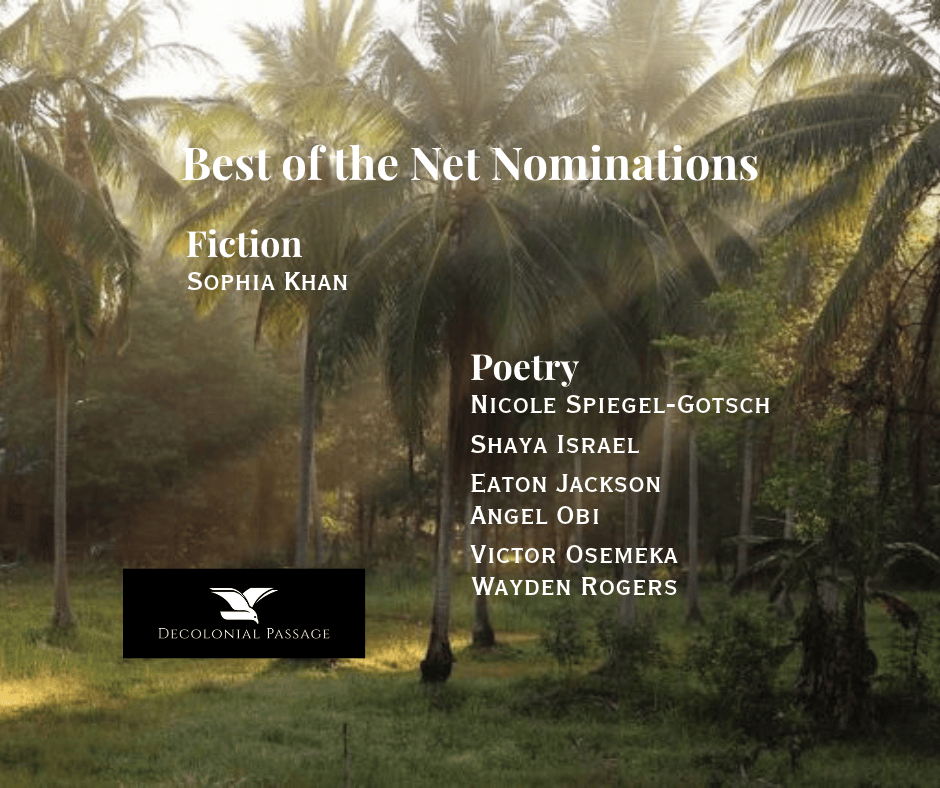
Best of the Net Nominations 2026
Announcing the Decolonial Passage Best of the Net nominees for 2026!
The Land Remembers
so many wars in the wind. beetles seeding tons of hate and revenge. birds drop weapons. something beautiful grows ugly. the climate fevers. icebergs sink. the desert storms. insects extinct. the land dries. the seed dies. we uproot. no archives.
Why did the plastic bag cross the road?
if I were free / I would climb up and demote him / The weaver birds and owls / might cheer me on
Frenzy
Many of us heard that the forest was due to be destroyed, or, in the parlance of the day, commodified. We had seen it so many times before, but something was different. We left our desks, our brick boxes, our prisons of fractured time and subordinated spirit. We finally, finally, listened.
Crickets
one crooked wing rubs another
and men in suits drop bombs
the first crickets fell in love
how can we call ourselves human
No Tedium Today
Instead I’ll take in placid beauty / of a slowly subsiding afternoon, / lofty clear blue sky, with pinkish / hue that clings to the ambient air / shimmering above most brightly.
The Pondless Blue Nishikigoï
When the Tokugawa regime ended, Western ships brought coal-powered engines leaking soot into the harbors. Then came thousands of sunken ships and submarines leaking oil, fuel, and heavy metals during the Russo-Japanese War. Smoke and ash settled into the ocean after the Great Kantō Earthquake. Unexploded bombs, torpedoes, and mines followed, then mercury and asbestos during World War II.
Tombs Called Homes
The sun has been rising hot for the last couple of years to the point that entire agricultural seasons have shifted. White people are calling it global warming, but the farmers who cannot afford irrigation systems say, “The rains are not falling when they are supposed to, so our crops are dying.”
The River Remembers
My father is from Gros Morne, in the department of Artibonite, named after the river. The Artibonite — the longest river on the island, and the second longest in the Caribbean — nourished my ancestors long before I was born. I had never crossed it, but I understood what rivers mean in Haiti. I had crossed others in Jérémie, where I was born.
witching snare
jorobadas—that is, bowed back / las ballenas como signos ortográficos / marcando el síntoma del mar / es decir—lugar de lucimiento / sus espaldas & sus lunares / es decir los cráteres encarnados / la tierra un lugar postizo / i mean / look at their lungs, like bellows, with no sound / the only sound / coming from the little range / hidden in the vast foliage
The Eucalyptus
I wonder:
if nature teaches by example.
If we ever listen, take a moment to hear the rustle
the polite screams of caution
An Acknowledgement
Too late for this mass of fallen ash
smothering saplings,
bored by beetles borne on ships’ hulls,
beetles from the east (I’m told).
Just as plagues passed between nations

