“and neither of them ever/
said what they meant/
and i guess nobody ever does”
“Sometimes you gotta’ take a stand. You can’t let people do what they do—you don’t have any representation anywhere. Don’t nobody in Baton Rouge give a flip about you…If you don’t take a stand, that means that you are giving consent for people to do what they do.”
12/15/2024 – 11:00 PM
To Samuel Earl Mims, my Paw Paw:
I don’t know if people are conscious of their last moments when they go; I will always remember yours. You were lying next to my father, watching the Packers trounce the Seahawks. The hospice nurse had just informed you—precisely and clinically—that you had very little time left. But while we were all reckoning with disbelief, you seemed devoid of panic; you chose to spend the rest of your life with your son and your wife and all the other people who mattered to you the most. You were always decisive that way. I got to call you briefly before you went quiet for the last time. I used that brief window of time to tell you all the things that I should have said to you when you weren’t standing in such intimate proximity to death.
I know now, after the fact, that I should have called you more, but calling you, every time, meant confronting the fact that you were leaving. The evidence of that passing showed itself in the thinning of your bones and the weariness behind your steps. Death loomed over you in such a way that I could not help but avert my gaze, to look anywhere and at anything other than reality; but in those short moments of courage in which I was able to confront death (and therefore see you), I noticed a brilliant irony: you were stronger than ever. Even with your hollowed-out muscles and wobbling limbs, you beat death back from you with such intensity and determination. You were the immovable object standing in the way of the unstoppable force that comes, eventually, for us all.
Last summer, another white nurse in a white lab coat told us that you would not make it through the fall, and yet here you were, on the phone with me, still fighting, in the middle of December. I recognize now that you were the type of Black man who lived his entire life defying the condemnations and expectations of white people; it only made sense that your death would be a similar demonstration of that old John Henryism. Still, regret seized my heart and mind; it occurred to me, as I was confessing to you the things that needed to be said between us, that we Black men have nurtured a counter-intuitive, and perhaps violent, tradition.
Why is it that we only share the most necessary words when we are hanging so perilously close to a precipice? It also occurred to me that, because you couldn’t reply in your condition, this might be the only conversation we ever have where I get the last word. It may be the only conversation you’ve ever had where someone else procured the last word. And then you slipped; that’s the best way I can articulate it. One moment you were here moaning and groaning, caught in that invisible struggle against time, and then you were gone; silence and death rushed in to fill you up—all the spaces that had, only moments ago, been saturated with love, wisdom, and strength. And as your body emptied itself of you, I felt something dense, firm, and perfectly unnamable fill my own. I suspect that I may spend my entire life trying to define this sense of transference, but in trying to define this new weight, I have been forced to reflect on your life and, therefore, my own.
You were raised in Louisiana; I was raised in Georgia. From a young age, we both witnessed what is undoubtedly a genocide ferociously nipping at the heels of Black children. The great orators of the Sorrow Songs, folks like Bessie Smith and Billie Holiday, and Nina Simone, gave form to the reality of this genocide in their songs and wailings. Every American has seen, in all its horrible glory, the strange fruit—the bleeding, broken body of a Black child taken too early. And with each bloody rendition of this American archetype, that festering rot that we call injustice grows ever more pervasive, embittering the air all around us.
Everyone can see the fruit, but few are cognizant of the roots, the seeds, or even the stems of the issue. The branches of the massacre tree run its fingers through the prisons, where 1.1 million men who look like us remain enslaved under a caveat of the 13th Amendment, and through White America’s obsession with guns, the same ones that fire disproportionately through the streets of Atlanta, Chicago, and Shreveport. A long and verdant field of white supremacy nurtures these violent realities, maintained only by the phenomena described so eloquently by Ralph Ellison. The modern American has rendered himself selectively mute, blind, and deaf to his history; he refuses to see that he has constructed his democracy atop the bones of an entire people!
Still, the roots of the problem, the source of that willful disability, undoubtedly begin in the classroom. You know as well as I do that Fred Hampton does not exist in Southern history books, and Angela Davis’s testimonies have similarly been obliterated from the curriculum. The classrooms of Georgia Public Schools consistently fail to mention the lives of Baldwin, Cleaver, and Giovanni.
The only images of Black excellence my classmates and I received were the vague silhouette of Martin Luther King Jr., intentionally watered down, and perhaps a (hyperbolically propagandized) caricature of X. I did not discover those other heroes until I went to college; instead, every February, for seventeen long years, we were told that we descended from slaves and that King was the sole Black participant in American history—an eloquent accident of the white man’s burden. Anyone could see how a student who was told that he emerged from a culture without value would struggle to even dream of self-esteem under these conditions. To make matters worse, the reality taught in the classrooms, of Black people in bondage, is corroborated by the news networks in the homes; thus, many of my friends and associates viewed the prisons as an inevitable destination on the horizon. This is the deathly pedagogy that instructs its darker-hued students to march dutifully, unquestionably towards death.
I grew up under this system, but I did not struggle, like so many do, to develop a sense of self-worth. I’ve never imagined myself in chains, and I have, for the most part, always assumed that some relative success would come my way. And I managed this without Baldwin or Giovanni or Du Bois; I managed to construct a dream for myself out of nothing. But what I now realize is that the only reason I was able to escape the mental trap of the not-so-far-from-Jim-Crow South is that I had the privilege of watching you do it first. In a state known for having the highest incarceration rate for Black men, you went to college. Not only that, but you did it only ten years after the country began to, legally, move towards integration.
You went on to join the US Military in 1969, where you served in Germany and Korea and attained the rank of colonel, after finishing your bachelor’s degree, and you only allowed yourself the relief of retirement after thirty long years of commendable service. That was in ‘99, two years after I emerged into this world. By then, you’d shifted your focus to activism. You’ve facilitated peaceful protests between the Minden Police Department and local citizens. Later, you went on to adorn the uniform yourself as a school resource officer, hoping to intervene in the lives of young people before they were swallowed up in our world of narratives.
As a leader in the Concerned Citizens Campaign, you helped advocate for the safe disposal and removal of fifteen million pounds of explosives at Camp Minden and the prevention of “open burn”, ultimately preserving the environment of the area to this day. But I think the work that you were most proud of was that which you did as a religious leader. After spending eleven years serving as a minister at Galilee Ministry Baptist Church, you built your own church, the Shepherd’s Hut, which has donated thousands of dollars to local public schools throughout Webster Parish.
I have realized, growing up, that to many members of our community, you are some strange amalgamation of folklore hero and legend, but to me, you’ve always just been my grandfather. That is not to say that I did not realize that you were a great man. On the contrary, you always made exceptionalism and greatness seem so natural; it emanated from you in such a way that success seemed as inexorable, for you, as the tide’s coming and going. Now that you have passed, I can admit to myself that there have been times when I have wondered if I could ever live up to the standard you set before me. I now realize that your example was never meant to be a shadow from which I should emerge; rather, your legacy has served as a shield, protecting me from the fate that has overcome so many of my friends and associates, the children of the world who wear skin painted so much like my own. In a time and place carefully constructed to ensure your failure, you have managed to navigate the world with integrity. And so, once again, even though I did not stumble upon the Harlem Renaissance or the Black Arts Movement or the Black Power concept until many later years, I never had to wonder what type of man or person I wanted to be in this world. I always had you to model that for me. Your example has unhindered me from many of the challenges that I could have all too easily faced.
Last year, when this all began, before you were diagnosed, but after the pain started to needle at your heart, we snuck out of the house while my grandmother was busy, loaded ourselves into your pickup truck, and absconded with some meat pies from the local gas station. GG had just put you on what you called a “vegan diet,” —which was really just a diet with slightly less salt, and you asked me to help you cheat the warden. After we had our pies, you wiped the grease off your stained overalls and said to me, “You watch a baby grow up into a man and then a man regress right into a baby.” It occurred to me then that you’d impossibly waged war against Jim Crow for your entire life to maintain your dignity, and you feared that death would rob you of it. As I said before, I don’t know if people are conscious of their final moments, but I can assure you that you left this world with the same grace and dignity with which you lived. And for me, a child who has grown up as a grim spectator to the slaughters of Trayvon Martin, Freddie Gray, and so many others, I cannot tell you enough how much I needed you to show me that it is possible to live beyond the terms set forth by the historical record. You spent twenty-seven years teaching me how to live in this world with integrity; you have now shown me, like a gilded north star, how to die with it intact. Throughout this week, I have felt your passing in waves of terrible anaphora; the grief truly comes and goes. But one thing that has stayed with me all my life is pride in being your grandson.
I want you to know, wherever you are now, I will not allow time to end your sermons. Your words will continue on through my voice and actions, and in every single word I write from this point forward. My father, uncle, sister, and I carry your initials; this Christmas, you gifted us each with the weight of your legacy.
Rest easy, Paw Paw. We will carry it from here.
–Your Grandson,
Stone Erickson Mims
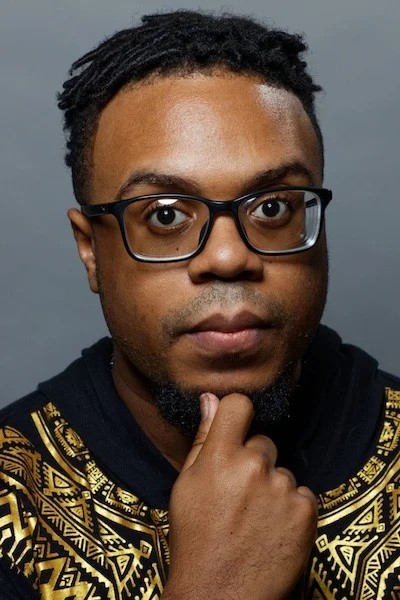
Stone Mims is a writer and educator based in Northern Michigan. His work, both in the classroom and on the page, examines the complexities of Black life. He holds an MFA in Creative Writing from The New School and a BA from Bard College. Mims has been a writer-in-residence at Château d’Orquevaux and attended the Kenyon Review Writers Workshop. His memoir-in-essays, Just Another Native Son, was a category winner in the 2025 Memoir Prize for Books from Memoir Magazine. His writing has appeared in Politics/Letters Live and Ignatian Literary Magazine. He is currently represented by Midnight Literary Agency. You can find him on Instagram.

 the Decolonial Passage