I never had a crush on David Lee Roth, but he had a crush on me. And, he sang a song about it. You remember the video. David dressed as a tour guide leading tourists through sunny California, dancing around bikini clad girls singing, “I wish they all could be California girls…” On the beach, at a movie studio, so many girls in bikinis and with big Aqua Net stiff hair teased up much higher than David’s golden locks. He just loves these California girls. And well, that’s me. But wait…
There are no brown-skinned girls in this video. Tan, yes. Brown? No. And my hair? My hair is actually too big to be teased up to look big. My hair is long almost down my back, but it’s thick and frizzy and more like Diana-Ross-Central-Park-in-the-rain concert hair than bikini-clad-blonde-on-Venice-Beach hair. So, am I a California girl?
In fact, it wasn’t David Lee Roth’s song anyway. It was the Beach Boys’ song. They’re the original ones who loved California girls. As long as they had blonde-bobs-on-the-beach hair. Yes, bikinis and tanned bods. Not the 80s, but women in the 60s doing the jerk while the band defines the quintessentially endless summer sound and California lifestyle. And there are no brown skinned girls.
There’s cute, perky surfer girl Gidget. Not Sally Field Gidget. But Sandra Dee Gidget. The one that personified the California vibe in the 60s. The one that made everyone who wasn’t a Californian want to move to California and buy a surfboard and live on a Malibu beach for the summer. And it was always summer. Blonde Gidget. Is it her? Is Gidget the culprit? Is she the one that made every media image of a California girl thereafter blonde, tan, and bikini clad?
Seriously there are so many California blondes. Not just any blondes but the ones that defined the “California girl.” The Bionic Woman. I did not have a crush on David Lee Roth, but I did have a crush on the Bionic Woman. She was blonde and beautiful and could rip the yellow pages in half. And she had a bionic ear that could hear across long distances. I mean miles. She would push a blonde lock behind her ear and listen. Apparently bionic ears can hear for miles, but they cannot hear through hair. I couldn’t push a lock of hair behind my ear. Well, I could but it wouldn’t stay there. My hair was not tame. It was wild and did what it wanted to do. The Bionic Woman was indeed a California girl. She lived in Ojai. You can’t get more California than that. Unless, of course, you lived in Malibu.
The Bionic Woman’s boyfriend was the Six Million Dollar Man. The Ken to Jamie Somers’s Barbie. The Six Million Dollar Man was played by Lee Majors who was married to the very blonde Farrah Fawcett. Another quintessentially California girl (even though she was from Texas). Fawcett was Jill Monroe — the blonde on Charlie’s Angels with feathered hair bouncing in the wind as she chased down criminals. She ran the way boys run when their peers say, “You run like a girl.” Farrah was the breakout star of that show. And yes, you can find pics of the ultra-feminine Fawcett trying to look like a tomboy skateboarding Dogtown style down the street. But more importantly, there is the poster — Farrah, sitting in front of a striped Mexican blanket wearing a red bikini, one knee up, one leg down, head cocked back in a smile that shows all of her white, perfectly straight teeth. It is very California, and it is said to be the best-selling poster ever. I did not look like Farrah Fawcett. I tried to cut and feather my own bangs and ended up with an afro on my forehead.
Maybe that’s when I stopped trying to be the California girl. Yeah, I was born and raised in L.A. and went to school so close to the beach that the boys would surf every morning before making their way to class. I said “grody” and “gag me with a spoon” and “groovy.” But I wasn’t Gidget, or Farrah Fawcett or Lindsay Wagner. I wasn’t Pamela Anderson in another red bathing suit saving lives on a Malibu Beach. I wasn’t Angelyne or Malibu Barbie. I wasn’t even Bo Derek, hair adorned in cornrows, running in slow motion on a misty seashore.
I was the brown-skinned, frizzy-haired girl. Born of a Japanese American mother and Black father. My Japanese grandmother was Nissei, first generation born in San Francisco, California in 1913. My paternal grandparents came to California from Baton Rouge, Louisiana. My parents met in the Bay Area, and I was born and raised by my single mom in L.A. We did not live near the beach. We did not live in a sprawling, ranch-style home like all those blonde Brady girls. We lived in a two-bedroom apartment in a neighborhood both affectionately and derisively called the Jungle. With its grassy lawns and abundant foliage, it was the perfect playground for bike riding, hula hooping, sock ball, and tree climbing. But the crack-laden 80s and 90s made it resemble more the urban hellscape of Boyz in the Hood than the dreamy paradise of The Endless Summer.
But this, too, is a California story. Better than the glossy, glamorized image projected on television, this California is real. It’s brown-skinned and frizzy-haired, and mixed-race, and multicultural, and queer, and it’s me. I’m it. California is after all named after me. Not as if David Lee Roth had a crush on me but instead, where the name comes from. According to the book, California Place Names, “[t]he term originally referred to a mythical land of Amazons, ruled by the beautiful black queen Calafia, as described in the Spanish novel, Las Sergas de Esplandian.” It’s me!
The city of my birth, Los Angeles, was inhabited by the indigenous Tongva people and was founded by a band of 44 pobladores who settled the area in the 1700s. These pobladores were of Spanish, Indigenous, and African origin. Brown-skinned. Pio Pico, the first governor of California under Mexican rule, designated Los Angeles the state’s capital. Yes, the Pico that the boulevard is named for, and he was mestizo, mixed with African, Indigenous, and Spanish ancestry. Brown-skinned.
The bouncy, blonde surfer girl version of California leaves out the Chinese immigrants who worked in the Gold Rush, the Japanese farmers who were later interned in concentration camps, the Mexicans and Native Americans who were here before the state was annexed to the U.S. The African Americans who brought jazz and soul and hip hop to waft along the Santa Ana winds with the Beach Boys and Van Halen and the Red Hot Chili Peppers. It left out the non-blondes who made the state what it was and is today. And by the way, surfing was invented by brown-skinned Polynesians, and Malibu is a Chumash word meaning “it’s loud over there” in reference to the waves of the unruly sea. Wild like my untamed hair.
I want to take a black crayon to plain white paper and draw a thickly bordered square. Above it, I want to draw a triangle and give the square a roof to make a house I never lived in. I want to take a brick red crayon and draw a rectangle for a chimney. And a gray crayon to draw a curlicue of smoke coming from the chimney I never had. I want to take a yellow crayon and draw a circle for the sun and a sky-blue crayon to outline perfectly fluffy clouds. It will be the home I never had but for some reason the one I always drew at school when my teachers asked me to draw a house. I imagine it on a perfectly manicured California street. Under it, I want to pick up a black marker like a French teacher and write “Ceci n’est pas une maison.” This is not a house. Like that painting of a very realistic, very idealized pipe under which Magritte wrote “Ceci n’est pas une pipe.” Because it wasn’t a pipe, it was a painting of a pipe. And this drawing wasn’t my house. And that California was not California at all.
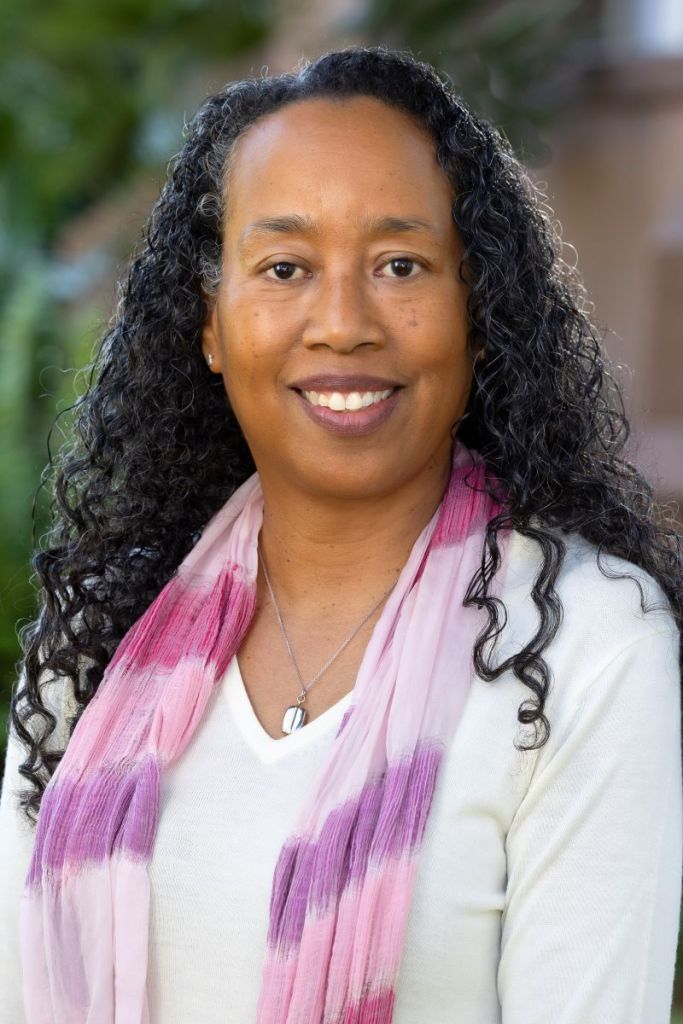
Kimberly Nao was born and raised in Los Angeles, California where she works as a professor of education at Mount Saint Mary’s University. She is the founder of Nao & Associates, a DEI and antiracism consulting agency. Her current projects include integrating contemplative practices in education, helping organizations engage in antiracist practices, and researching the historical landscape of Black Los Angeles. As a certified yoga and mindfulness facilitator, Kimberly believes that self-awareness and compassion for others leads to social transformation.
 the Decolonial Passage