
I could always tell when my Haa-mee was enjoying herself – she would forget to hide her tattoos. Around people outside our family, she placed her hands in her lap with the palms facing up or held them behind her back, palms out. When she waited on customers at her and Grandpa’s grocery store, she wore a kimono with long drapey sleeves that slid over her hands, hiding them from sight. Sometimes she wore rubber gloves. When I was small, I didn’t understand why she didn’t want strangers to see the dark geometric designs inked into the tops of her hands and wrists. I found them fascinating – something from another time and place, though nothing to do with me and my American life. But she seemed embarrassed, and I absorbed her discomfort.
Later I learned that all the girls in her Okinawan village received such tattoos as a form of spiritual protection and a sign of readiness for marriage. At age 19, she sailed to San Francisco to become my grandfather’s “picture bride.” But she saw that American women and even the other Japanese women did not have tattoos, and she must have felt “differentness” for the first time. Even though Japan had annexed Okinawa twenty years before she was born, Haa-mee’s generation never thought of themselves as Japanese. And though Japan banned tattooing, many families continued the practice in secret. The Ryukyu Islands, now the prefectures of Okinawa and Kagoshima, had been a separate kingdom for centuries, and the people kept to their own customs and language – Japan could not change who they were by issuing an edict.
I’ve lived in the Bay Area for years now, with only sporadic visits home to St. Paul. So busy with work and my husband’s family events, always reasons not to make the trip. But Mom’s voice on the phone is urgent – “Hannah, you need to come now. Haa-mee doesn’t have much longer.”
I arrive disheveled from a day of travel. My grandma looks tiny and pale, dozing in a hospital bed. “Haa-mee?” I whisper. She opens her eyes, which widen in surprise when she sees the indigo circles, squares, and elongated triangles inked into the skin of my outstretched fingers.
She pulls her hands from under the sheet, grasps my hands, and smiles.
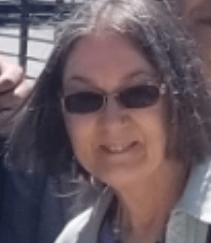
Elinor Davis was born in Iowa and led a peripatetic childhood. After finishing a BA in sociology and realizing she had no readily marketable skills, she also completed a nursing degree and license. Based in Northern California, she is a freelance writer/editor specializing in health care topics and mentoring writers for whom English is a second language. Her fiction and non-fiction work has appeared in numerous U.S. and international publications.
 the Decolonial Passage