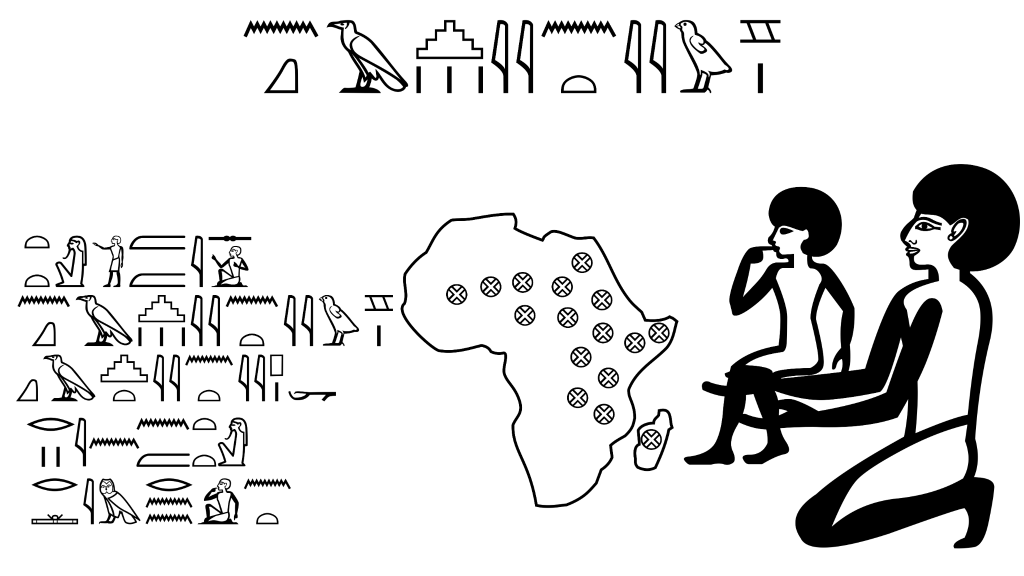
Ngur yina yɛ ɛ wo?

Tat e, mam ɛ zɛ?

Ngur yina yɛ ɛ wo?

Xara yina yɛ ɛ po?

Liia nɛ nam, tat

Lɛɛa mɛ lɛngina

Where is our ancient town?

Oh, father, who am I?

Where is our ancient town?

Where is our city ?

Talk to me, father

Tell me our history


P. Aubham Edouhou was born in Makokou (Gabon) and is a Bekwel and Ikota speaker. He graduated in Letters (Portuguese-English) from Pelotas Federal University (UFPel) in 2019. He has a Master’s degree in Letters (Language Studies) from the Federal University of Rio Grande (FURG) and is currently a doctoral student in Letters (Literary Studies) at the Federal University of Rio Grande do Sul (UFRGS) where he studies Kandian (African) Literature in Kandian languages. He promotes the hieroglyphization, coptization and meroitization of Kandian languages.

Decolonial Passage is honored to announce the nominations for next year’s Pushcart Prize Anthology. This list includes writing published during the 2025 calendar year. Congratulations to the nominees!


Poetry

Jesse Gabriel Gonzalez – “Moon Blues”

Yanis Iqbal – “and how shall i walk when the street sings of fire?”


Short Stories

.Chisaraokwu. – “The Visitor”


Essays/Memoirs

Bright Aboagye – “Do They See You?”

Stone Mims – “A Letter to My Grandfather”

Kimberly Nao – “I, too, am California”

This rented basement is soundproof, so when

the bass guitar of homesick, make-up band      shudders

for a gone homeland, it’s resonance

pounding into the ground floor,


island children become the beat,

with bones that are loosely hem together,

rocking to and fro against the wave of non-personhood,


because when the                                                   

village where I was born  drops into the

belly of the metropolis undigested it becomes,

in anonymous ways it falls back out as


droppings,


my village & I

& this second-hand bass guitar

if dropped in the belly of this township’s  lake

would no longer be    flotsam swirling downstream,


I am broad big nosed with a  high visibility quotient accent,

accented tongue tied  up in all of this,

I stay a little off     on the periphery

always with bilingual understanding  of other’s tossed epithets,


thinking if my village fell in their lake,

I’d be an anonymous, emaciated island,

banana republic slurs,


solace is in this party 

the bass guitar like a rebel   a    runaway note  

from impersonal stiff-upper lips,


and the bass reminds my bones that I am             free

and the unkept  bass stands away from the corralling,

pounding, deep pounding heartbeats, the floor to trembling

and the bass is deep down the basement of this patrolled township


because my village is uncomfortable in the belly of the metropolis

and I dance because I am free,

I dance because the bass is a lone


actor


breaking the coupling links,

blistered fingers thumbing pylon strings,

because my birth village lives in this bass sound.


White Shirts Came in the Dark — Took Away Emmett Till

those shirts

that were washed clean & crisp

fluttering in an eerie breeze,

no evidence of the meandering blood,

of the boy

at the bottom of the reticent river,


in monochrome circa pictorials

of pyrrhic victory

leaning  on their arms their unblemished starlets,

a legal rinsing, that remake the guilty sinless,


some pieces of the Mississippi soil was of  a silent hypocrisy

some pieces of the land was less hostile,

& still some pieces of the land opened up willingly

to hide the drip  the  drip staining secrets,


upturned   uprooted stones

tire tracks in putty slurry mud,

silent mud, conspiratorial reticent mud,


white shirts that were washed clean of stains

iron crisp like  newly minted dollar bills,


multifaceted monochrome story,

of a boy yanked from innocent sleep,

bleary eyed, forcing his heels to fit in his shoes,

it’s a boy      stillness     of a  boy

at the bottom of a river of death,


of other folks in white shirts

washed clean also,

and the boy, inflated with carbuncle unearthed from the bottom

of the unwashed

never to be cleaned river.


Eaton Jackson is a Jamaican-born writer, living in America. His work traverses the fault lines of migration, faith, and resistance. Rooted in the dual consciousness of island and diaspora, these writings speak against erasure by reclaiming language and memory from colonial afterlives. His works have been published in Passager Journal and Kinship Quarterly. Eaton’s writing envisions freedom not as a destination, but as a continual, communal practice of becoming.

As I was kidnapped

As I was disappeared

As I was tortured

As I was murdered

My only consolation

Was

Your words

Your laugh

Your sorrow

You

American friend

Who offered me

A hug

Before returning to

Domestic bacteria

As I was kidnapped

As I was disappeared

As I was tortured

As I was murdered


Eraldo Souza dos Santos (they/them/theirs) is an Afro-Indigenous historian and writer from Rio de Janeiro, Brazil. They are currently writing a family memoir with their mother, Nilva Moreira de Souza, probing how she, then a seven-year-old child, was sold into slavery during Brazil’s military dictatorship in the late 1960s. Pieces stemming from this project are forthcoming in Best Small Fictions 2025 and POETRY Magazine. Souza dos Santos has been selected by Yaddo, the Blue Mountain Center, the Kimmel Harding Nelson Center for the Arts, the Oxford Centre for Life-Writing, the 2025 Tin House Autumn Online Workshop, and the 100th Middlebury Bread Loaf Writers’ Conference to work on this project. You can find him on Twitter/X, Blue Sky, and Instagram.

Decolonial Passage is honored to announce the 2025 nominations for the Best of the Net Anthology.  This list includes writing published between July 1, 2024 and June 30, 2025.  Congratulations to the nominees!


Poetry

“His Tousled Hair, His Toothly Grin” by Eric Braude

“color you dark” by Ashley Collins

“The Ancestor’s Song” by Leslie Dianne

“Sonics” by Joanne Godley


Fiction

“Michael, Deportee” by Stephenjohn Holgate

“From Glasgow Without Love” by Albrin Junior


Creative Nonfiction

“I, too, am California” by Kimberly Nao

“Note From Nonpeople” by Serhat Tutkal

When the flooding starts, and the rich flock to

their yachts, the rest of us will inherit the beach-front views

only to climb up trees and whine at God—but you promised!


And God, starting his Prius, shouts back something about carbon

footprints: his but the size of a seraphim’s, ours lug-soled

and everywhere, even the damn Moon.


And that will be that; we’ll re-draw the maps and

eat more fish. Eventually, tired of tuna, the yachts

become rockets, sailing through the thickened atmosphere.


When the terraforming starts, wheat will be the first to fail;

the last will be rice, abandoned in the smaller craters.

In the end, palm trees will populate the Moon.


It makes sense, the Moon having everything they need:

sandy dirt, unfiltered sunlight, and islands, which,

in the absence of liquid water, deliver the seas


and wide-open shores palmeras crave, deep in their green hearts.

If the Antilles can hook-and-crook the Caribbean from the Atlantic,

surely Tranquility can be found cleaving to its own islands:


the wreck of the Ranger; the breezeless flag; the sunken

heel of a tall boot…indeed, palm trees were made for the Moon.

Too frugal now for fire, the rich will scrap their ships by hand,


committing to this one last colonial undertaking.

Foundations will be dug, small houses hammered out

and thatched over, all beneath great glass domes and the future.


Back on Earth, most of us will be dead, but hey—we got a

brand new Moon, which, as always, watches, spinning

its gears against gravity, the tempo of the spheres.


The palm trees, in their understanding, try to show the Moon

what comes next. It’s one thing to be a fixed point in an idea

of the sky, eclipsed at a distance by the transit of catastrophe—


it’s another thing entirely to brace against a heaving chest, carrying,

not by choice, the shadow puppets of fire and smoothbore bullets.

But matches are rationed now, posing too great a risk to the domes,


guns a laughable waste of precious metal.  Yes,                 

World War Moon will be fought with sticks and stones and

coconuts. And the domes will hold up marvelously.


And when the Moon spins on, with no one left to inherit the shade,

maybe the few of us on Earth will look up and whisper blessed be

the palm trees, for theirs is the kingdom of Heaven — or, at least, good night.


Jesse Gabriel González is a poet from the great state of New Jersey. He holds an MFA from the University of Oregon and a BA from Cornell University. He was the recipient of a Contributor Award from Bread Loaf and an Anaphora Arts fellowship. His poetry appears in The Seventh Wave. He serves as an Editorial Assistant for Poetry Northwest.

the soil does not shake—
it memorizes.
here, even the stones rehearse their lines
in syllables of smoke.
a man’s words dry in mid-prayer,
still tasting dust from last week’s funeral.
the wind is a radio station now—
it plays a scream remixed into pop beats,
go back, snake, traitor, rapist, rootless goat,
the chorus looped with the smell
of sandalwood and burning tires.

a pony rider in the hills
bled into a pine tree,
and the sap does not know
whether to clot or to weep.
he was reciting,
not a creed,
but the names of his daughters.

in the plains,
a woman strings her silence
into a necklace of broken SIM cards,
walks sideways past the temple’s loudspeaker
blaring the anthem of a war
she never enlisted in.
her grocer now sells her rice
as if measuring gunpowder.

every window is a gun barrel,
every child’s name
a reason to evacuate the future.
in Agra, they buried a man
without his name—
only a label:
“retribution.”
it is easier that way,
easier for the press release,
easier for the bullet.

who attacked whom?
the question dies in the first comment thread.
facts are too slow.
truth is throttled by 4G
and dressed in a uniform of pixels—
AI-generated martyrdom,
HD nationalism with export-quality rage.

they uploaded a song
before the blood dried.
it asked us to leave.
leave what?
the land that remembers our ancestors’ coughs,
the wells we named after heartbreak,
the callouses of our dead
still softened in its soil?

He wears his beard like a crosshairs.
his name is a GPS tag.
he walks into a clinic,
and the doctor’s eyes
scan him for nations.
no illness,
only allegiances.

tell me,
how shall i carry my skin
when it is now a declaration?
how to walk into a school
where history has been rewritten
as an eviction notice?

the country
is an anthem sung backwards.
its rivers choke on slogans.
its justice is a bulldozer
that has forgotten how to pause.

and still—
we mourn the dead.
even when mourning itself
is suspect,
surveilled,
licensed.

they ask:
why didn’t you go?

but tell me,
what do you call leaving
when your body itself
is the country’s last remaining witness?


 Yanis Iqbal is studying at Aligarh Muslim University, India. He is the author of the book Education in the Age of Neoliberal Dystopia (Midwestern Marx Publishing Press, 2024) and has a forthcoming book on Palestine and anti-imperialist political philosophy with Iskra Books. His poems have been published in outlets such as Radical Art Review, Rabble Review, The Ekphrastic Review, Culture Matters, Live Wire, Apocalypse Confidential, Neologism Poetry Journal, Bitter Melon Review, Cafe Dissensus, Palestine Chronicle, Frontier Weekly, and others. Two of his poems were also selected for inclusion in The Anthology of Contemporary Poetry: Meet the Poets of Today. You can find him on Twitter/X at @yanisiqbal.

after Benjamin Netanyahu,

United States Congress, July 24, 2024


In America, a murderer receives a standing ovation.

Meanwhile, bodies tally against the ground faster

than we can count.

I can’t quite decide what is more disturbing;

the chilling sound of applause cheering genocide,

or the large-scale catastrophe scorching the world.


It’s difficult to hope. It’s difficult to still believe in

our deserved forgiveness.


But I return to that soft and tender place in me that

reaches beyond anger. I return, again, to the wide open

grief stretched before us like a prayer rug. Not just for

the violence, but for the ineffable conditions that create

hardened cruelty in the hearts of the few, and the

unnerving ignorance shielding empathy from the many.


Towards what end do we hope to arrive? The only land

we get to own is the mapped terrain between first gasp

and final whimper. Nothing else is truly ours. Not even

this perennial breath we’ve been given.


What then? After your clapping victory.

What will you do with the terror in your heart?


Moudi Sbeity is a first-generation Lebanese-American poet and transpersonal therapist, and the author of the forthcoming books Want A World (Fernwood Press, 2026) and Habibi Means Beloved (University of Utah Press, 2026). In a previous life, Moudi co-owned and operated Laziz Kitchen, a Lebanese restaurant in Salt Lake City. Moudi was also a named plaintiff in Kitchen v. Herbert, the landmark case that brought marriage equality to Utah in 2014. As a person who stutters, they are passionate about writing and poetry as practices in fluency and self-expression. They call the Rocky Mountains in Boulder, Colorado home. Find them on Instagram at @moudi.sbeity and on Substack at moudisbeity.substack.com.

the night comes for us,

when mercenaries

scan palm leaves

for drops of blood

of martyrs. martyrs who

write poems about

the living. martyrs

left dead to the

pulses of the solo river

without a sound.

the night comes for us

as suharto flies turbo jet

bullets through the sky

as if timor could never

rest and if they rest then

kissinger cuts his molars

in washington restlessly

calling to some

lockheed factory in louisiana,

flat rate

express delivery

to indonesia.

the family of deer in the

presidential palace graze

on dirty money reserves

turbo jet bulleting from

the cayman islands.

the night comes for us.

the sparrows

silent witness

silent extrajudicial

bullets upon our dissent.

every worker is a fugitive under martial law.

the sparrows

continue their flight.

the night comes for us.

even in death

kissinger never

lets go of his choking hands.

if night surrenders

to moonlight,

we will hear the martyrs speak.


Patricia Kusumaningtyas is a tech worker and film/music writer based in Brooklyn, NY. Their poetry and prose have been published in Discount Guillotine, Fruitslice, Major 7th Magazine, and Dead End Zine.

Start small:

pour a glass of wine like you mean it.

Toast to the black dog pawing through snow,

leaving tracks that look like hieroglyphs

for “almost.”


Outside, the trees lean conspiratorially.

Inside, the cat reads your mind

and knocks a glass off the counter.

You laugh—

but it sounds wrong, like broken glass,

or an old cassette tape unraveling.


The news came in last week:

Colleen’s gone.

Julie’s gone.

You’re still here,

dancing to a Beatles record

because grief won’t let you sit still.

The groove is a time machine;

the lyrics are a curse.


At some point,

you’ll stand on the porch,

watching a hydrangea fight

for its life in the wind,

and think:

This is survival.

This is all it ever was.


Sabyasachi Roy is an academic writer, poet, artist, and photographer. He contributes craft essays to Authors Publish as a guest writer. His poetry has been published in The Broken Spine, Stand, Poetry Salzburg Review, Dicey Brown, The Potomac, and other print and online magazines. He has written several essays on wildlife and culture, and he is a published photographer with a cover image in Sanctuary Asia. Find him on EyeEm at sabyasachi13 and on instagram at pensoftworks.

From high-end restaurants

to invitation-only shops. Department

store spies have shadowed me.


An outcast in exquisite malls

featuring items they assume are

beyond this minority’s grasp.


Pure judgment in their eyes

I sense when I arrive. It’s always

‘that look,’ and thought process.


“Who let you in?”

“How can you afford to walk through

these doors?”

“Wrong color, wrong place.”


I have received this slight

despite my talent or intellect.

Snide compliments behind smiles.


It’s a look I have witnessed

and learned to ignore from racists,

and elitists who still believe in ‘Jim Crow’

laws.


I am well aware of my skin tone

and the unwarranted bias produced.

I belong where my life takes me

your opinion is not invited to attend.


Dana I. Hunter (she/her) holds the title of Top Poet in the NAMI NJ: Dara Axelrod Expressive Arts Poetry Contest and has been featured in Heather Stivison’s Ekphrasis! Poets Respond to Art in the Gallery. She was featured at Pleiades Gallery in NYC and has been published in table/FEAST Literary Magazine, The National & International Goddess Anthology 2024, The Journal of Undiscovered Poets, and Open Minds Quarterly. She has a B.A. in Mass Communications and resides in New Jersey.

The sky is cracked

The stars are not hiding

And the Earth suffers it all.


The moon shrivels to a sickle

I’ve been nibbling it every night

Now the constellations are my clock.


All the trees dry their clothes

Only the fig tree shares its shade

My garden has grown into a desert.


Heaven has sailed far from me

My Earth is sinking like a boat

Wind lifts dust to the mountaintop.


Everything that belongs to me scatters

Soya beans, sorghum, bananas blow away

My world has been swept away by wind.


Heart’s Desert

You sink in sands of sorrow

Drenching all chambers with drought.


The well is far from my workplace

I’m drowning with a dry throat.


I dream of downpours pounding the dam

But rise to the reality of roughness. 


Thirst has burnt the building

The blaze blocks all exits.


Your desert slithers like fire

You burn in a sea of sand.


Trycent Milimo is a Zambian based rising author of poetry, fiction and children’s books. His writing is featured in two Sotrane Publishers anthologies — Centennial Reflection: Celebrating the Life and Legacy of Kenneth Kaunda, and the TriState anthology, Reflection on Political, Economic and Cultural Independence in Post-Colonial Rhodesia and Nyasaland. He is the 2024 regional winner of the inaugural Bridgette James online poetry competition. The poem was then featured in the PENNED IN RAGE online journal. He is the 2024 third runner up for Zambian Best Poet Valentine poetry competition and was shortlisted for Zambian Arts Publishing House Valentine poetry competition.

For Neida


What is black, white, and red all over if not checkered

flannel and blood: the Chola enclosure.

Forgive me, Father, for I have survived despite cops’

best efforts to send me into that good night.

Two times now, I’ve gone running with pigs at my back, hoping,

wishing, my little siblings see me get back.

I was in the fields fighting those red clowns, but in

my heart of hearts, I’m not truly down.

I ripped off their paisley bandanas, all

for the girl who called me ‘mana.

Por mi culpa por mi culpa por mi gran culpa, the

navy beads on my neck, son mi disculpa,

I pray for a rider, the ones with polished metal, to

take my siblings far away to something betta’,

I rebel, I rebel to stay in the house tonight,

there’s a war on the streets, and I have been asked to fight.

My mother won’t look at me, and my father’s gone cold,

and the only gift I’ve gotten was not to grow old,

I turned fourteen, grabbed a switchblade, dark lip liner,

and concealer to hide my new shiner.

Cordero de dios, que quitas el pecado del mundo,

nos dejastes en esa casa y eso no fue justo

The only love I know is from the end of a belt,

and my brother and my sister don’t know the hand they been dealt.

So hear out my bargain as it stays between you and me,

the three dots on my cheek mean the holy trinity

Keep me from losing breath while I run on the gravel,

and send us an angel with nimbus and dazzle,

for you my lord I’ll lay down the navy

if you keep my parents away from us babies.


Noel Munguia-Moreno is a first-year poetry MFA candidate at Rutgers-Newark where he teaches Intro to Creative Writing. He spends too much of his time thinking about which coffee to drink or laughing at horror movies. He writes of heritage, the physical land and environment, and our individual myths. Find him on Instagram at noel_fromhell.

I teach​ poetry to my students at university.


            I tell them all about

                        Eliot’s objective correlative

                        Keats’s negative capability

                        Coleridge’s organic unity


            I make sure they understand

                        rhyme, rhythm, prosody

                        alliteration, allusion, apostrophe

                        metonymy, metaphor, synecdoche

                        imagery, symbolism, hyperbole

                        enjambment, anaphora, blah blah blah


            I teach them 

                        all that I’ve been taught

                        by my poetry professors

            and they seem happy!

I teach​ poetry to my students
but      

what I don’t teach them is that


none of this stuff makes great poets
or real poetry!


that to become a poet

you need to have had your home
            stolen from you

            your dreams confiscated,

            your hopes held hostage


you need to have heard

            the cacophony of the Merkava

            the bellowing of the bulldozer

to have appreciated the irony
            when your ancestral olive trees
            became charcoal
you need to have heard

            the onomatopoeia

                        in the roar of the rocket
                        in the bomb’s boom
                        to have spotted the alliteration in

                        “we will waste you in the womb!”


To write poetry
you need to have seen
            your brother blown to pieces

you need to have spotted
            your sister’s curly hair
            under a mountain of rubble
            to have removed her teddy bear
            from her loosening embrace

            to have wiped blood clots
            off her face


you need to have seen
            tearless mothers
            identifying their sons

            one after another
            in mass graves

            fathers

            rocking their pale princesses to sleep

                        fast, sound, deep!

you need to have known

            what it feels like

            to write your name
            on your small limbs

            so they may identify you

            when you become unidentifiable
you need to have learned

            how to swallow
            the sight of your best friend’s
            charred body
            to get used to the word “gone”

                           one
                                       by
                                                one.


To be a poet
you need to have seen this
            known this
                        felt this
with every cell in your body
and that is ​why
                         Palestine

has so many great poets.


Forgive me, my students!

I have lied
                and lied
                             and I am ashamed of myself.


Hossein Nazari is an Assistant Professor of English literature, a translator, and poet. He writes poetry in English and Persian and has translated poems between the two languages. His academic articles on English literature, including on such poets as W. B. Yeats, Czesław Miłosz, Robert Frost, John Milton, T. S. Eliot, and Sylvia Plath have appeared in many prestigious international journals. Hossein’s poetry explores the themes of displacement, exile, loss, home(lessness), memory, identity, and nostalgia.

University of Cape Town, 1966


Not six feet from me,

Bobby Kennedy,

about two countries 

settled by the Dutch, British,


one went astray—

South Africa, I heard.


When I settled in America,

anti-apartheid meetings thrilled  me—

injustice anywhere is injustice

everywhere scrawled on walls.


Now I know The Talk,

of men who produce a video—

a black man running from their guns—

as “evidence” that shooting him


was justified.

Kennedy’s strayed country

(I looked it up)

was not South Africa.


Uprising

We felt South Africa from our feet, 

toes browned by common dust,

for all that we knew 

we knew by raw sole.


Worn paths among bush,

our quiet dread of snakes,

the hard reddish soil, 

rose through our loins. 


Avocado trees crept low,

branches for cradles. There,

when off our feet, we hung,

chatting till the sun blew out.


Durban 1965

Alan Paton, a writer, led South Africa’s Liberal Party.


Brylcreemed, he scowls,

invoking The Almighty. 


One Man One Vote.

The government threatens


to take him down 

to solitary the instant


he slips from fame abroad. 

Two men in hats and well-


pressed suits, backs to speaker, 

shunt from listener


to listener, as if collecting

in a church—big one’s notepad


open for interrogations, small one

kneeling with his massive apparatus,


taking frontal flashbulb photos. I think 

I’m followed home.


Eric Braude grew up in South Africa. He won the 27th annual Eagle-Tribune/Robert Frost Foundation Spring Poetry Contest and wrote the front matter poem for the anthology Songs from the Castle’s Remains. His poetry has appeared in South Florida Poetry Journal, Constellations, Apple Valley Review, J Journal. I-70 Review, Panoplyzine, Book of Matches, Frost Meadow Review and elsewhere. His work has been nominated for a Pushcart Prize. Eric is a computer science professor at Boston University.