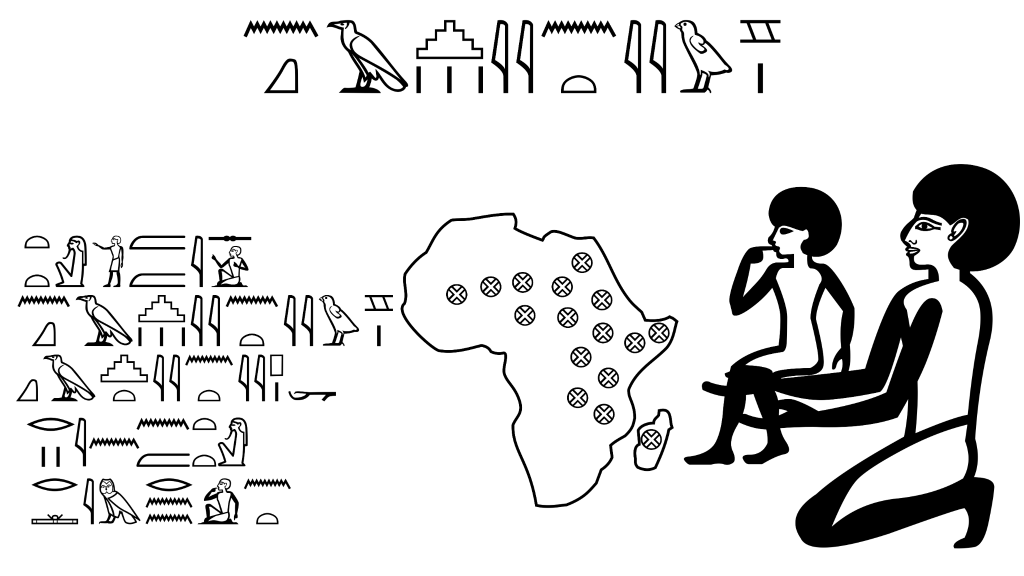
Ngur yina yɛ ɛ wo?

Tat e, mam ɛ zɛ?

Ngur yina yɛ ɛ wo?

Xara yina yɛ ɛ po?

Liia nɛ nam, tat

Lɛɛa mɛ lɛngina

Where is our ancient town?

Oh, father, who am I?

Where is our ancient town?

Where is our city ?

Talk to me, father

Tell me our history


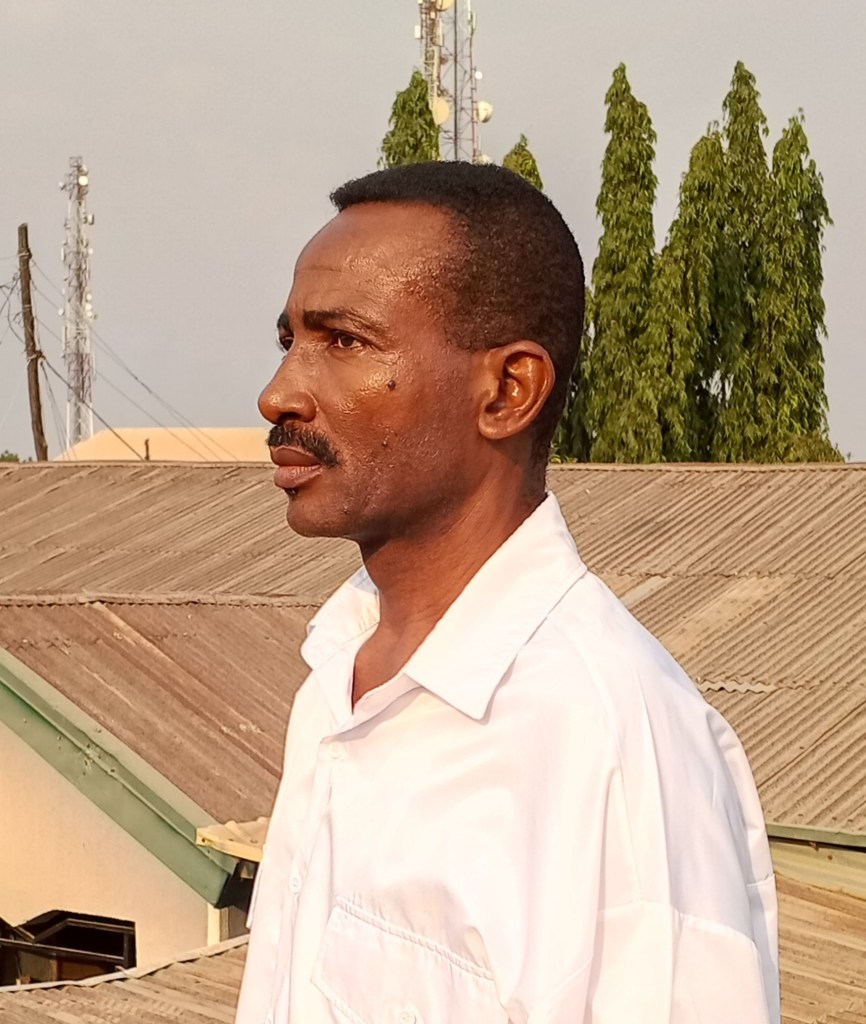
P. Aubham Edouhou was born in Makokou (Gabon) and is a Bekwel and Ikota speaker. He graduated in Letters (Portuguese-English) from Pelotas Federal University (UFPel) in 2019. He has a Master’s degree in Letters (Language Studies) from the Federal University of Rio Grande (FURG) and is currently a doctoral student in Letters (Literary Studies) at the Federal University of Rio Grande do Sul (UFRGS) where he studies Kandian (African) Literature in Kandian languages. He promotes the hieroglyphization, coptization and meroitization of Kandian languages.

Decolonial Passage is honored to announce the nominations for next year’s Pushcart Prize Anthology. This list includes writing published during the 2025 calendar year. Congratulations to the nominees!


Poetry

Jesse Gabriel Gonzalez – “Moon Blues”

Yanis Iqbal – “and how shall i walk when the street sings of fire?”


Short Stories

.Chisaraokwu. – “The Visitor”


Essays/Memoirs

Bright Aboagye – “Do They See You?”

Stone Mims – “A Letter to My Grandfather”

Kimberly Nao – “I, too, am California”

This rented basement is soundproof, so when

the bass guitar of homesick, make-up band      shudders

for a gone homeland, it’s resonance

pounding into the ground floor,


island children become the beat,

with bones that are loosely hem together,

rocking to and fro against the wave of non-personhood,


because when the                                                   

village where I was born  drops into the

belly of the metropolis undigested it becomes,

in anonymous ways it falls back out as


droppings,


my village & I

& this second-hand bass guitar

if dropped in the belly of this township’s  lake

would no longer be    flotsam swirling downstream,


I am broad big nosed with a  high visibility quotient accent,

accented tongue tied  up in all of this,

I stay a little off     on the periphery

always with bilingual understanding  of other’s tossed epithets,


thinking if my village fell in their lake,

I’d be an anonymous, emaciated island,

banana republic slurs,


solace is in this party 

the bass guitar like a rebel   a    runaway note  

from impersonal stiff-upper lips,


and the bass reminds my bones that I am             free

and the unkept  bass stands away from the corralling,

pounding, deep pounding heartbeats, the floor to trembling

and the bass is deep down the basement of this patrolled township


because my village is uncomfortable in the belly of the metropolis

and I dance because I am free,

I dance because the bass is a lone


actor


breaking the coupling links,

blistered fingers thumbing pylon strings,

because my birth village lives in this bass sound.


White Shirts Came in the Dark — Took Away Emmett Till

those shirts

that were washed clean & crisp

fluttering in an eerie breeze,

no evidence of the meandering blood,

of the boy

at the bottom of the reticent river,


in monochrome circa pictorials

of pyrrhic victory

leaning  on their arms their unblemished starlets,

a legal rinsing, that remake the guilty sinless,


some pieces of the Mississippi soil was of  a silent hypocrisy

some pieces of the land was less hostile,

& still some pieces of the land opened up willingly

to hide the drip  the  drip staining secrets,


upturned   uprooted stones

tire tracks in putty slurry mud,

silent mud, conspiratorial reticent mud,


white shirts that were washed clean of stains

iron crisp like  newly minted dollar bills,


multifaceted monochrome story,

of a boy yanked from innocent sleep,

bleary eyed, forcing his heels to fit in his shoes,

it’s a boy      stillness     of a  boy

at the bottom of a river of death,


of other folks in white shirts

washed clean also,

and the boy, inflated with carbuncle unearthed from the bottom

of the unwashed

never to be cleaned river.


Eaton Jackson is a Jamaican-born writer, living in America. His work traverses the fault lines of migration, faith, and resistance. Rooted in the dual consciousness of island and diaspora, these writings speak against erasure by reclaiming language and memory from colonial afterlives. His works have been published in Passager Journal and Kinship Quarterly. Eaton’s writing envisions freedom not as a destination, but as a continual, communal practice of becoming.

Decolonial Passage is honored to announce the nominations for next year’s Best American Essays Anthology. This list includes writing published in 2025. Congratulations to the nominees!


“A Letter to My Grandfather” by Stone Mims


“I, too, am California” by Kimberly Nao


“Eid Mubarak, America” by Gemini Wahhaj

Daniel picked up the sandwich as a black ant’s head appeared above the paper plate’s rim.  Antennae wiggling in time with the hum of the house’s A/C unit, the ant paused, assessing the situation.

“It’s OK,” Daniel said, breaking off a few crumb-sized pieces of bread and dropping them onto the plate.

Stomach rumbling, he bit into the sandwich. Dry meatloaf between two stale pieces of hard bread.  No ketchup, mustard, or mayonnaise. Chewing steadily, he tried to turn the lump in his mouth into something edible. As he swallowed, he felt the thick, gummy wad scrape down his throat.    

Earlier that Saturday morning, Daniel was surprised to see his eight-year-old sister drawing at the kitchen table.

“You got baseball?” she asked.

“No.  Work.”

“Dad said we might go to the town pool.”

“Uh-huh.  What you drawing?”

She held up the paper, revealing a rough sketch of a cerapter.

“Pretty good.” The mythical unicorn with wings was one of her favorite things. Drawings and posters of it decorated her bedroom walls.   

Daniel bit into the sandwich as the ant climbed over the rim and onto the plate. He’d planned to go home for lunch. But the man insisted Daniel stay and said he’d give him lunch, as if afraid Daniel would leave and not return. So, here he was, sitting on the concrete backsteps of the man’s house in the sun.

The death of Michael’s father had made no sense to Daniel. But death itself wasn’t something any twelve-year-old fully understood. The week before, in a father and son softball game, Michael’s father hit a blast that shattered a row of lights in the center field tower. The following Monday morning, after saying he didn’t feel like himself, he returned to bed. As she sat weeping at the funeral, Michael’s mother repeatedly mumbled, “He’d never been sick a day in his life.” 

Daniel and Michael met while playing town soccer when they were six. They quickly discovered they lived three blocks from each other and shared an obsession with Spiderman. South of Maple Street, where Daniel lived, Black families now owned every house previously inhabited by white families. Michael lived on Hadley Ave. Hadley and the section of town north of it remained an exclusively white residential area. The areas were separated by three blocks of properties owned by absentee landlords. Rents there were cheap, and the tenants tended to be transient. That area was strewn with dog feces, Styrofoam cups, and fast-food wrappers the wind blew onto the well-maintained properties to its north and south.   

Daniel finished the sandwich, stood up, and stretched. Though the intense heat and humidity had drained his adolescent body’s energy, he was determined to complete the task.

Seeing the ant had carried away the crumbs, he walked down the steps, picked up the garden hose on the ground, and held its bare end away from himself. As he opened the water spigot and took a drink, he heard the man call to him.

 “All done?”

Closing the spigot, Daniel looked up. He raised a hand, sheltering his eyes. The man was on the landing atop the steps.  Daniel nodded. 

“Good.  Back to work then.” The man bent down, picked up the empty paper plate, and disappeared back inside the house.

Before Michael’s father’s death, there’d been no plans for Michael and his younger brother to visit their grandparents that summer. So, Daniel was surprised when Michael asked him to take over his lawn mowing and paper route customers until he returned.  Daniel agreed to do it, realizing the additional customers might help him to earn enough money to buy the sleek, black, three-speed boys’ bike on display in the downtown department store. Then he could give the hand-me-down girl’s bike he used to deliver newspapers to his sister.

Before leaving, Michael introduced Daniel to his customers. Most seemed fine with the

temporary arrangement, though Daniel did notice he got a few odd looks.

After mowing the man’s lawn earlier that week, the man told Daniel he had work for him on Saturday. Daniel said he could be there at 9 a.m., but the man insisted on 7. Daniel proposed 8.  But the man remained adamant about 7. So, not wanting to potentially jeopardize Michael’s relationship with his customer and having been taught to always behave respectfully to adults, he agreed to 7.

When he arrived that morning, the man led Daniel to the large moss-covered mound of dirt, rocks, and glass bottles. He told him he wanted it moved into the woods on the other side of the backyard. Then he gave him a shovel and a bushel basket.

After making a few trips with the bushel basket, Daniel spotted the rusty wheelbarrow leaning against the woodshed. On his first attempt, he overfilled it. It tipped and dumped the load.  His next effort ended when its wheel struck a tree root as he struggled to keep the wheelbarrow’s handles level. The tray then pitched sideways, spilling the load onto the ground. It took a few more tries before he finally got the hang of it.

Ready to resume working, Daniel picked up the pointed shovel and drove its blade into the mound. With slightly more than a week until school started, the money he’d earn today would likely ensure he could buy the bike.

Working through the afternoon, a layer of sweat built on Daniel’s skin. Calluses and blisters surfaced on his hands. Ravenous mosquitoes in the woods attacked him, and the

earthy odor of its black soil and decaying fallen trees covered with sprouted mushrooms grew more intense. He soon lost track of the number of trips he’d made, but finally, by late afternoon,

he’d finished.

“All done?” called out the man from the back door’s landing as the house’s central A/C fan shut off.

“Yup,” answered Daniel from alongside the shed, where he was placing the wheelbarrow, bushel basket, and shovel.

Avoiding contact with the black iron handrail on the steps, the man descended, huffing and puffing. 

“God, it’s hot,” he sighed upon reaching the bottom of the steps. He then pulled out a handkerchief and wiped his forehead. “Let’s see how you did.”

Daniel followed the man to where the mound had been. He watched him inspect the area, then trailed him into the woods. 

“Good job,” said the man, nodding. He reached into his pants pocket and withdrew a fist. “Here.  This is for you.”

As he placed the money in Daniel’s palm, he wrapped his fingers around Daniel’s. 

“Don’t go spending it all on candy.” 

“I won’t. Thank you.”

“No. Thank you!” said the man. Then he released Daniel’s hand.  

 Daniel shoved the money into his pants pocket as they walked across the backyard side-by-side.  The man then told him he might have some more work for him next Saturday. They then said goodbye and parted.

Though his arms were aching and he felt tired, Daniel was pleased with the job he’d

done. About mid-way through the three blocks separating the Black and white sections of town,

he reached into his pocket and pulled out the wad of money. In his hand was three dollars.  Daniel immediately felt angry. Some customers always gave him more than they owed. Others often offered him lemonade or cookies after he mowed their lawns on scorchingly hot days.  Today, he’d missed baseball practice and worked all day. He’d assumed…  but then, he hadn’t asked about the job in advance or negotiated a price for doing it.

When he arrived home, Daniel went straight to his room. He put the three dollars with the other money he’d been saving in a tin can that summer. Then he stripped off his sweat-drenched clothes and went to take a shower. Though the cleansing water felt refreshing, its warmth made his mosquito bites itch.

 After dressing, Daniel counted his money. He then added what he expected to earn the remaining week of the summer. Despite repeating the calculations many times, there wouldn’t be enough money to buy the bike.

“You missed out.”

Daniel looked up. His sister was leaning against his bedroom door frame.  

“We even got slushies after we finished swimming.” She flashed a self-satisfied smile, then turned and walked away.

Sitting on his bed, Daniel tried to think how he could earn the money he needed. The man had said he might have some other work available.  But for three dollars? 

With school scheduled to start on Monday, Daniel stopped at the downtown store after baseball practice to buy the latest Spiderman comic books. Near the sporting goods aisle, he

saw the bike.  Feeling hopeful, he went over and checked its price. No reduction.

Daniel took hold of the bike’s handlebars, swung his right leg over the crossbar, and closed his eyes.  He imagined himself riding the bike through his neighborhood.

“Please don’t play with the merchandise unless you intend to buy it.”

Daniel’s eyes snapped open, and he looked at the female store clerk apologetically. He gave the bike’s handbrakes an affectionate parting squeeze and dismounted.

Following one last look at the bike, Daniel walked over to the comic book section of the store.  There, he selected two Spiderman comics to share with Michael upon his return. As Daniel approached the cash registers, he saw a large stuffed animal. A cerapter. He stopped and flipped its price tag right side up. Buying the comics and the cerapter would take almost all the money he’d earned that summer. Shaking his head, Daniel began walking away. But then he stopped, walked back, and wrapped an arm around the stuffed animal’s midsection.      


J L Higgs writes short stories from a Black American perspective that explore the interplay between human emotions and actions. Since July 2016, he has amassed over sixty publications along with a nomination for a Pushcart Prize. He resides outside Boston, Massachusetts. You can find him on Facebook.

“and neither of them ever/

said what they meant/

and i guess nobody ever does”

  • Nikki Giovanni

“Sometimes you gotta’ take a stand. You can’t let people do what they do—you don’t have any representation anywhere. Don’t nobody in Baton Rouge give a flip about you…If you don’t take a stand, that means that you are giving consent for people to do what they do.”

  • Samuel E. Mims


12/15/2024 – 11:00 PM

To Samuel Earl Mims, my Paw Paw:

I don’t know if people are conscious of their last moments when they go; I will always remember yours. You were lying next to my father, watching the Packers trounce the Seahawks. The hospice nurse had just informed you—precisely and clinically—that you had very little time left. But while we were all reckoning with disbelief, you seemed devoid of panic; you chose to spend the rest of your life with your son and your wife and all the other people who mattered to you the most. You were always decisive that way. I got to call you briefly before you went quiet for the last time. I used that brief window of time to tell you all the things that I should have said to you when you weren’t standing in such intimate proximity to death.


I know now, after the fact, that I should have called you more, but calling you, every time, meant confronting the fact that you were leaving. The evidence of that passing showed itself in the thinning of your bones and the weariness behind your steps. Death loomed over you in such a way that I could not help but avert my gaze, to look anywhere and at anything other than reality; but in those short moments of courage in which I was able to confront death (and therefore see you),  I noticed a brilliant irony: you were stronger than ever. Even with your hollowed-out muscles and wobbling limbs, you beat death back from you with such intensity and determination. You were the immovable object standing in the way of the unstoppable force that comes, eventually, for us all.


Last summer, another white nurse in a white lab coat told us that you would not make it through the fall, and yet here you were, on the phone with me, still fighting, in the middle of December. I recognize now that you were the type of Black man who lived his entire life defying the condemnations and expectations of white people; it only made sense that your death would be a similar demonstration of that old John Henryism. Still, regret seized my heart and mind; it occurred to me, as I was confessing to you the things that needed to be said between us, that we Black men have nurtured a counter-intuitive, and perhaps violent, tradition.

 
Why is it that we only share the most necessary words when we are hanging so perilously close to a precipice? It also occurred to me that, because you couldn’t reply in your condition, this might be the only conversation we ever have where I get the last word. It may be the only conversation you’ve ever had where someone else procured the last word. And then you slipped; that’s the best way I can articulate it. One moment you were here moaning and groaning, caught in that invisible struggle against time, and then you were gone; silence and death rushed in to fill you up—all the spaces that had, only moments ago, been saturated with love, wisdom, and strength. And as your body emptied itself of you, I felt something dense, firm, and perfectly unnamable fill my own. I suspect that I may spend my entire life trying to define this sense of transference, but in trying to define this new weight, I have been forced to reflect on your life and, therefore, my own.


You were raised in Louisiana; I was raised in Georgia. From a young age, we both witnessed what is undoubtedly a genocide ferociously nipping at the heels of Black children. The great orators of the Sorrow Songs, folks like Bessie Smith and Billie Holiday, and Nina Simone, gave form to the reality of this genocide in their songs and wailings. Every American has seen, in all its horrible glory, the strange fruit—the bleeding, broken body of a Black child taken too early. And with each bloody rendition of this American archetype, that festering rot that we call injustice grows ever more pervasive, embittering the air all around us.

 
Everyone can see the fruit, but few are cognizant of the roots, the seeds, or even the stems of the issue. The branches of the massacre tree run its fingers through the prisons, where 1.1 million men who look like us remain enslaved under a caveat of the 13th Amendment, and through White America’s obsession with guns, the same ones that fire disproportionately through the streets of Atlanta, Chicago, and Shreveport. A long and verdant field of white supremacy nurtures these violent realities, maintained only by the phenomena described so eloquently by Ralph Ellison. The modern American has rendered himself selectively mute, blind, and deaf to his history; he refuses to see that he has constructed his democracy atop the bones of an entire people!

Still, the roots of the problem, the source of that willful disability, undoubtedly begin in the classroom. You know as well as I do that Fred Hampton does not exist in Southern history books, and Angela Davis’s testimonies have similarly been obliterated from the curriculum. The classrooms of Georgia Public Schools consistently fail to mention the lives of Baldwin, Cleaver, and Giovanni.

The only images of Black excellence my classmates and I received were the vague silhouette of Martin Luther King Jr., intentionally watered down, and perhaps a (hyperbolically propagandized) caricature of X. I did not discover those other heroes until I went to college; instead, every February, for seventeen long years, we were told that we descended from slaves and that King was the sole Black participant in American history—an eloquent accident of the white man’s burden. Anyone could see how a student who was told that he emerged from a culture without value would struggle to even dream of self-esteem under these conditions. To make matters worse, the reality taught in the classrooms, of Black people in bondage, is corroborated by the news networks in the homes; thus, many of my friends and associates viewed the prisons as an inevitable destination on the horizon. This is the deathly pedagogy that instructs its darker-hued students to march dutifully, unquestionably towards death.


I grew up under this system, but I did not struggle, like so many do, to develop a sense of self-worth. I’ve never imagined myself in chains, and I have, for the most part, always assumed that some relative success would come my way. And I managed this without Baldwin or Giovanni or Du Bois; I managed to construct a dream for myself out of nothing. But what I now realize is that the only reason I was able to escape the mental trap of the not-so-far-from-Jim-Crow South is that I had the privilege of watching you do it first. In a state known for having the highest incarceration rate for Black men, you went to college. Not only that, but you did it only ten years after the country began to, legally, move towards integration.

You went on to join the US Military in 1969, where you served in Germany and Korea and attained the rank of colonel, after finishing your bachelor’s degree, and you only allowed yourself the relief of retirement after thirty long years of commendable service. That was in ‘99, two years after I emerged into this world. By then, you’d shifted your focus to activism. You’ve facilitated peaceful protests between the Minden Police Department and local citizens. Later, you went on to adorn the uniform yourself as a school resource officer, hoping to intervene in the lives of young people before they were swallowed up in our world of narratives.

As a leader in the Concerned Citizens Campaign, you helped advocate for the safe disposal and removal of fifteen million pounds of explosives at Camp Minden and the prevention of “open burn”, ultimately preserving the environment of the area to this day. But I think the work that you were most proud of was that which you did as a religious leader. After spending eleven years serving as a minister at Galilee Ministry Baptist Church, you built your own church, the Shepherd’s Hut, which has donated thousands of dollars to local public schools throughout Webster Parish.

I have realized, growing up, that to many members of our community, you are some strange amalgamation of folklore hero and legend, but to me, you’ve always just been my grandfather. That is not to say that I did not realize that you were a great man. On the contrary, you always made exceptionalism and greatness seem so natural; it emanated from you in such a way that success seemed as inexorable, for you, as the tide’s coming and going. Now that you have passed, I can admit to myself that there have been times when I have wondered if I could ever live up to the standard you set before me. I now realize that your example was never meant to be a shadow from which I should emerge; rather, your legacy has served as a shield, protecting me from the fate that has overcome so many of my friends and associates, the children of the world who wear skin painted so much like my own. In a time and place carefully constructed to ensure your failure, you have managed to navigate the world with integrity. And so, once again, even though I did not stumble upon the Harlem Renaissance or the Black Arts Movement or the Black Power concept until many later years, I never had to wonder what type of man or person I wanted to be in this world. I always had you to model that for me. Your example has unhindered me from many of the challenges that I could have all too easily faced. 


Last year, when this all began, before you were diagnosed, but after the pain started to needle at your heart, we snuck out of the house while my grandmother was busy, loaded ourselves into your pickup truck, and absconded with some meat pies from the local gas station. GG had just put you on what you called a “vegan diet,” —which was really just a diet with slightly less salt, and you asked me to help you cheat the warden. After we had our pies, you wiped the grease off your stained overalls and said to me, “You watch a baby grow up into a man and then a man regress right into a baby.” It occurred to me then that you’d impossibly waged war against Jim Crow for your entire life to maintain your dignity, and you feared that death would rob you of it. As I said before, I don’t know if people are conscious of their final moments, but I can assure you that you left this world with the same grace and dignity with which you lived. And for me, a child who has grown up as a grim spectator to the slaughters of Trayvon Martin, Freddie Gray, and so many others, I cannot tell you enough how much I needed you to show me that it is possible to live beyond the terms set forth by the historical record. You spent twenty-seven years teaching me how to live in this world with integrity; you have now shown me, like a gilded north star, how to die with it intact. Throughout this week, I have felt your passing in waves of terrible anaphora; the grief truly comes and goes. But one thing that has stayed with me all my life is pride in being your grandson.

I want you to know, wherever you are now, I will not allow time to end your sermons. Your words will continue on through my voice and actions, and in every single word I write from this point forward. My father, uncle, sister, and I carry your initials; this Christmas, you gifted us each with the weight of your legacy.

Rest easy, Paw Paw. We will carry it from here.

–Your Grandson,


Stone Erickson Mims


Stone Mims is a writer and educator based in Northern Michigan. His work, both in the classroom and on the page, examines the complexities of Black life. He holds an MFA in Creative Writing from The New School and a BA from Bard College. Mims has been a writer-in-residence at Château d’Orquevaux and attended the Kenyon Review Writers Workshop. His memoir-in-essays, Just Another Native Son, was a category winner in the 2025 Memoir Prize for Books from Memoir Magazine. His writing has appeared in Politics/Letters Live and Ignatian Literary Magazine. He is currently represented by Midnight Literary Agency. You can find him on Instagram.

As I was kidnapped

As I was disappeared

As I was tortured

As I was murdered

My only consolation

Was

Your words

Your laugh

Your sorrow

You

American friend

Who offered me

A hug

Before returning to

Domestic bacteria

As I was kidnapped

As I was disappeared

As I was tortured

As I was murdered


Eraldo Souza dos Santos (they/them/theirs) is an Afro-Indigenous historian and writer from Rio de Janeiro, Brazil. They are currently writing a family memoir with their mother, Nilva Moreira de Souza, probing how she, then a seven-year-old child, was sold into slavery during Brazil’s military dictatorship in the late 1960s. Pieces stemming from this project are forthcoming in Best Small Fictions 2025 and POETRY Magazine. Souza dos Santos has been selected by Yaddo, the Blue Mountain Center, the Kimmel Harding Nelson Center for the Arts, the Oxford Centre for Life-Writing, the 2025 Tin House Autumn Online Workshop, and the 100th Middlebury Bread Loaf Writers’ Conference to work on this project. You can find him on Twitter/X, Blue Sky, and Instagram.

And you were inconsolable.

Initially when they rescued you half dead at the shore, you barely cried over the loss of your husband. But some weeks afterwards, you started crying profusely. No one knew why, except you. No one knew the details of the boat accident.

You and your husband both loved to sail. And that day you both set out, an uneasy calm lay between you.

But then, the storm happened. The weather changed from sunny with clear skies to dark and grey with heavy rainfall which quickly turned to a storm, a deadly one.

You were a much better swimmer so, when the boat capsized, you held on to a plank, able to fight against the powerful currents. But your husband of ten years wasn’t as good as you. He panicked and cried out, his eyes scared. He held out his hands expecting you to save him, even as he fought in futility against the strong currents. You looked at him, your eyes cold and unfeeling, seeing opportunity in this misfortune.

And the strong waves of the sea swept him away in minutes with the debris of the boat, his cries ringing in your ears. Somehow you made it to shore.

Everyone thought you had tried to save him, tried your best. Everyone also thought you had a perfect marriage. But you and he knew there were cracks, he was already discussing with a divorce lawyer how to be rid of the marriage as he had found someone new. What was most painful for you, seeing as you both had no children, was that he was already in talks with his legal adviser on changing his will, a will that named you his sole beneficiary.

You had been considering your options since you knew, so the storm was a blessing in disguise, a way to be rid of your husband and then come in possession of all that was rightfully yours.

But now? The problem was a heavy weight of guilt lay on your shoulders. From where? Just weeks after his funeral, you could not fathom. This was the cause of the tears.

Not only that, but you now had nightmares where he appeared to you, his eyes scared and his cries of anguish making you go crazy.


Solape Adetutu Adeyemi is a dedicated professional with a Bachelor’s in Microbiology and a Master’s in Environmental Management. She is a researcher, consultant, passionate environmental sustainability enthusiast, and a talented award-winning creative writer with work published in Writenow Literary Journal, Poetry Marathon Anthology, Kalahari Review, Indiana Review, TV Metro, and The Guardian among others. Find her on Facebook at Solape Adeyemi.

All you ever wanted was to be seen. For someone to read your writing, give remarks, identify you, respond, criticize, and recognize your work. Although it never happens, you share your writing: hoping it will resonate, hoping they will love it, hoping someone will notice your tone, hoping that life will be better after all.

No retweets, no reshares, not even a casual, “This was nice.”

And every time, there’s a distinctive level to the pitch following the uncountable rejections you have received: from the magazines you admire, from people who claim to “support upcoming writers.” And every time you send work to them, there’s a beauty in how they bounce back to you with an “unfortunately”.

The sadness wells up, pushing at the back of your eyes, threatening to tumble and rain down. Your mind floats to everything you’ve tried. Every thought that has rained in your mind. You just want to be heard, to have someone see you, for people to read and cherish the gift/curse you’ve always had.

***

You’d written what you thought was your best. You spent hours reading and rereading, trying to get it just right. And still, they didn’t see you. And when someone finally did, they didn’t listen. They didn’t understand the fight in your words, the way you were writing for more than yourself, for your family, for your future, and for the dreams you thought were simply living in your head.

Every story you wrote was a piece of your life. You’d disguised it in other characters and other settings, but it was always you in there: your struggles, your hopes, your truths, dancing with reality within the lines.

***

That night, as you walk into Valco Hall, the heavens open into you, and you look for a sign to sort your problems. You think about what you’ll say to Fatau, your roommate. You’ll ask him for help for the first time. You don’t want to; nonetheless, you’re running out of options. You don’t want to bother your mother. She’s done too much already, always standing by you, always encouraging you even when things were hard. You know she doesn’t have the money.

Today feels like your last chance. You know Fatau will say yes if you ask. He’s kind, always thoughtful, and has shown you how good he can be. However, you’re not close to him. You’ve never been close to anyone.

Most of the time in the room, it’s just you. Talking to yourself, laughing at your own jokes, planning stories in your head, and speaking out loud to yourself. You’ve read your drafts alone and clapped for yourself because no one else ever did. Fatau never noticed. He probably thought you were mad. Or he never heard you probably.

When you step into the room, his friend is there. The one with the braids, the one from your mother’s home country. You’ve never told him that. He might ask too many questions, and you don’t feel the urge to answer him. You are never fond of sharing too much about yourself.

You greet them, but they don’t even look up. They’re busy, playing on the PS5, their faces lit up by the movements on the screen and their mouths shouting out words to people who only live in such realities. You move around the room, from your bed to the balcony, hoping both will notice you, say something. Recognize your agitation. They don’t.

That’s how it’s always been.

***

You think about the time you tweeted, tagging all those advertising agencies, hoping someone would see it. No one did. You remember scrolling through LinkedIn, sending messages to HR managers, and pouring out your heart into every word. One of them read your message. You saw the “seen” tick, but he never replied.

In your emails, you even said, “If you’re not interested, just send me a rejection. I’ll understand.” They didn’t bother. You followed up, again and again, sending more messages into the same nothingness.

You think back to the time you waited for a response from Ogilvy, your dream company. The delay dragged on until you gave up, deciding to move on and start school again. Then, out of nowhere, they called you for an interview. You sat across from them, explaining that you were now back in school. They nodded politely, and you knew in that second, the job was gone before it even began.

You remember that day. The day you received a call from Insel Communications, the rush of adrenaline as you checked your balance. Twenty-five Ghana cedis. Just enough for an Uber to East Legon. You booked the ride anyway, stomach tight with worry, but excitement overflowing in your soul the way a caged bird sings of freedom. You had been waiting for this.

The boss was accommodating. He was short and made sure his words carried the room, making him taller than his frame. He was in a meeting. You knew it had to be the Gong Gong Awards. You had spent nights combing through industry articles, memorizing jury members’ names like a desperate student before an exam. Your life, at that point, revolved around these professionals, their movements, their triumphs. You followed them the way the tide follows the moon — pulled, fidgety, unable to resist, and determined to play its part.

Then you saw him.

A glance. No! It was a frozen second suspended on the screen, appearing with every wish that you had once made to be near him.

 Andrew Ackah. The man whose career you had studied the way Christians study the scripture. His words had guided your dreams, his achievements, a map to places you wanted to go. You had stalked his life online, knew the places he worked, the books he recommended, the speeches he gave, and even where he stayed with his family. And now, here he was, a few feet away, discussing something with the director of Insel online. You needed the job more than anything just so you could… be so close to your industry idol, just so your dreams could sprout from the ground.

While still in the meeting, the director turned to you and asked about your favorite book.

Gone Girl” you said without thinking. A lie. A reflex. You couldn’t have told him the truth. You couldn’t have said your favorite book was by Akwaeke Emezi, a writer whose words were home to you but whose identity you feared would betray you before you even had a chance.

Then came the test. The page in front of you looked surprising. The creativity you carried as a second skin abandoned you. This is copywriting? You knew, even before handing the horrible handwriting back to them, that you weren’t going to get the job. The Uber fare had been a gamble you lost. So, you walked.

From East Legon to Bawaleshie to Legon. The rain came down in sheets, filling your shoes, soaking into every piece of your trousers and the white boxer shorts you bought before the Kantamanto fires. You prayed. Not for another job, not even for a sign. It should just be for something, anything, to remind you that you were still headed in the right direction.

Four days later, hunger was eating itself around your stomach. You lay on your bed, staring at the ceiling when your phone rang. Regina, an administrator from another company. A meeting on Monday.

This time, you borrowed from MTN Quick Loan.

The journey was long. A crawl through traffic, through neighborhoods that screamed wealth and places you had never been. The estate was lovely, your first time in one. You wanted to work there. To belong there, to smell like them. And you crossed your hands to do your best in the interview.

Thomas, the boss, liked you or so you thought. You could tell from the way his eyes shone when you spoke, the way he nodded, delighted and impressed with your background.

“Great diction,” he said. “You’re eloquent. You have quite a presence.”

And for a moment, just a moment, you believed you had finally found a place where you fit.

Then you walked out, the door clicking shut behind you. But something kept your feet planted just outside, your breath moving in rhythm to your curiosity. You listened to him and the other board members.

Laughter. Its sound had cruelty in its throat. The one that stung more than mosquito bites.

“He’s too effeminate. Probably gay. Sounds too much like a girl.”

The words cut like glass lodged in the gums, impossible to ignore. And your mouth opened in shock to the words. Your breath faster, heartbeat swifter, the promise of belonging disappearing behind the door as you bid bye to the estate.

They never called back.

And despite your follow-ups, your emails, and your polite check-ins, the silence was its own kind of answer.

***

It wasn’t the first time life had teased you with possibilities only to snatch them away. After your bachelor’s degree, you struggled just to start National Service. When you finally got a placement, you worked hard, but no one noticed. You felt invisible. It’s almost as if you didn’t exist in the same world as everyone else. You were a ghost people spoke to when needed and ignored when you desired them to see you.

You dreamed of studying abroad, of leaving everything behind to start fresh. But when you asked for help, no one came through and it was a battle too big for you to even start. After National Service, you sat at home, endlessly applying for jobs. Every email you sent felt more personal than the last, and the rejection came like rain in June.

You thought going back to school would fix everything. Another degree?! Surely that would open doors you reassured yourself. You gathered what little savings you had left to buy the university forms, not even sure where the money to pay the fees would come from.

Your mother, who always stood by you and supported you, scraped together what she could. She used the last of her savings to help pay half the fees after you got admission. That left you to figure out how to survive.

Feeding yourself? You didn’t know how you’d manage, so you left it in God’s hands and hoped for the best.

***

The first day you walked into Legon Interdenominational Church, you hoped to find something more than sermons and praises. Perhaps someone there would see you, connect with you, and perhaps help you. Instead, you got leftover food and free meals from the events you attended. You were grateful and ashamed, feeling smaller with every bite that you took.

And then there was love. Or at least, what you thought was love. It arrived like a promise and left you the way a bad memory is never forgotten. Your honesty became a joke; your confession was something to laugh about, and the betrayal following it stung so painfully in your heart that it left you questioning if anything in your life was real.

***

You think about the day you wanted to end it all. You were tired. Too tired of fighting, exhausted from trying, bushed out of feeling as though nothing you did would ever be enough. That was the day someone finally noticed you. He reached out to help, but even then, he didn’t listen. He didn’t hear the way you were saying you couldn’t take it anymore. He should have just let you be without interfering with your journey to the next life.

And you’re still here. Somehow, you kept going on.

It’s hope that keeps you moving, stubborn, and persistent in the way a weed grows out through a crack in the pavement. Or maybe it’s just the voice inside you that refuses to give up.

Now, you stand on the balcony with the cool metal rail under your fingers as you stare out at the night. You feel invisible; you always do. A part of you wants to scream, to force the world to turn and look at you. The words fail you. Your mouth is buried inside.

Sometimes, you wonder if it’s because you’re a man — the reason no one sees you and makes your struggles easy to ignore. You think about the female celebrities whose beauty seems to do all the talking, opening doors and winning attention in ways you can’t.

You blame something bigger. It’s not you at all. Possibly, it’s the country: the way it feels like it’s designed to work against you and the way your soles crack from running around. You keep trying, putting in the effort. Trying, and yielding to a lack of results. It’s as if the system is broken. As if no matter how hard you try, the soil just won’t give back your results.

It feels like God has forgotten you. He doesn’t see you. You’ve prayed so many times, poured out your heart, fasted, and still nothing changes. No answer, no sign, no rain. Just nothing. The faith you once held onto so tightly now feels shaky, and it could slip away at any point in time.

You climb into bed, your roommate and his friend still glued to their video game, still not paying you any attention. You pull the sheet over your head, trying to block out the world and let everything disappear. The sadness feels enormous. It’s pulling you under, and you let it. You let your thoughts carry you away, far from the noise, far from everything. Far into somewhere else.


Bright Aboagye counts Aja Monet and Akwaeke Emezi amongst his influences. He dreams of becoming a surrealist blues poet, writer, and restaurant entrepreneur. Bright hopes that his work inspires and gives hope to all who engage with it.  He can be found on Medium, Blogspot, and Linkedin.

The way he hoists the bag of rice over his shoulders — slouched under the weight, but moving with grim, determined purpose. Exquisite. Sure, he’s got a bit of pudge. But haven’t we all? I’m certainly no peak male specimen. Could stand to lose a few pounds, trim a few hairs.

I’m not judging—only admiring how masterfully he carries the bag. If rice-hauling were an Olympic sport, he’d podium without question.

This is pure respect. Athlete to athlete.

I’m not attracted to him. At least… I don’t think I am. I spent a few formative summers at conversion camp. Daily prayers. Ice baths with shards so sharp it’d cut any temptation right out. One counselor, Brett, said it came from the Devil.

I like to think they did their job. Especially Brett. Though he seemed to struggle with temptation himself — mostly after lights went out. I try not to think about it.

So no — definitely not attraction. Just deep, reverential appreciation… of the human form in motion.

My ex used to say I didn’t appreciate her body. I did. She was like a painting — curves, color, softness in all the right places. I admired her the way you admire something in a museum: respectfully, from a distance, trying not to touch anything.

Sure, sometimes things didn’t… function. But that’s normal. Performance anxiety affects a lot of households. Viagra is a billion-dollar industry for a reason. Millions of couples suffer every year.

That’s why I like being back down South. Feels like there are plenty of men here who just get it. Nobody says anything, of course. Not at church, not anywhere public. But there’s a kind of silent nod we all share.

She wouldn’t understand. So no, I don’t mind that she kicked me out. More time for community, I’d say. Out here, we don’t need fancy labels like “homosexual.” We just keep to ourselves. God-fearing men. Men like my Pa. Men who respect hard work.

Like the rice-bagger. God, he’s good at working. So good. There’s a rhythm to it — shoulders straining, back glistening, that steady, unbothered focus. He was built for labor.

And those scars. Pale whip streaks across his back. He must’ve gone to one of those camps. If not, maybe his Pa just picked up the slack. Hard to say. Could be either.

I think I’m gonna ask him out for a beer. Nothing weird—just to say I respect his work ethic. One hard-working man to another.

And the way he’s been looking at me lately?

I think he gets it.


Sanum Patel is a South Asian writer and attorney based in New York City. He writes both to unsettle and make you laugh, exploring emotional complexity wherever it lives. His writing has appeared in Out Front Magazine, Silly Goose Press, Poetry for Mental Health, and Little Old Lady Comedy. He has been recognized with personal editorial notes by The Missouri Review. You can find him at www.sanumpatel.com and on instagram at sanumpatel. 

Decolonial Passage is honored to announce the 2025 nominations for the Best of the Net Anthology.  This list includes writing published between July 1, 2024 and June 30, 2025.  Congratulations to the nominees!


Poetry

“His Tousled Hair, His Toothly Grin” by Eric Braude

“color you dark” by Ashley Collins

“The Ancestor’s Song” by Leslie Dianne

“Sonics” by Joanne Godley


Fiction

“Michael, Deportee” by Stephenjohn Holgate

“From Glasgow Without Love” by Albrin Junior


Creative Nonfiction

“I, too, am California” by Kimberly Nao

“Note From Nonpeople” by Serhat Tutkal

When the flooding starts, and the rich flock to

their yachts, the rest of us will inherit the beach-front views

only to climb up trees and whine at God—but you promised!


And God, starting his Prius, shouts back something about carbon

footprints: his but the size of a seraphim’s, ours lug-soled

and everywhere, even the damn Moon.


And that will be that; we’ll re-draw the maps and

eat more fish. Eventually, tired of tuna, the yachts

become rockets, sailing through the thickened atmosphere.


When the terraforming starts, wheat will be the first to fail;

the last will be rice, abandoned in the smaller craters.

In the end, palm trees will populate the Moon.


It makes sense, the Moon having everything they need:

sandy dirt, unfiltered sunlight, and islands, which,

in the absence of liquid water, deliver the seas


and wide-open shores palmeras crave, deep in their green hearts.

If the Antilles can hook-and-crook the Caribbean from the Atlantic,

surely Tranquility can be found cleaving to its own islands:


the wreck of the Ranger; the breezeless flag; the sunken

heel of a tall boot…indeed, palm trees were made for the Moon.

Too frugal now for fire, the rich will scrap their ships by hand,


committing to this one last colonial undertaking.

Foundations will be dug, small houses hammered out

and thatched over, all beneath great glass domes and the future.


Back on Earth, most of us will be dead, but hey—we got a

brand new Moon, which, as always, watches, spinning

its gears against gravity, the tempo of the spheres.


The palm trees, in their understanding, try to show the Moon

what comes next. It’s one thing to be a fixed point in an idea

of the sky, eclipsed at a distance by the transit of catastrophe—


it’s another thing entirely to brace against a heaving chest, carrying,

not by choice, the shadow puppets of fire and smoothbore bullets.

But matches are rationed now, posing too great a risk to the domes,


guns a laughable waste of precious metal.  Yes,                 

World War Moon will be fought with sticks and stones and

coconuts. And the domes will hold up marvelously.


And when the Moon spins on, with no one left to inherit the shade,

maybe the few of us on Earth will look up and whisper blessed be

the palm trees, for theirs is the kingdom of Heaven — or, at least, good night.


Jesse Gabriel González is a poet from the great state of New Jersey. He holds an MFA from the University of Oregon and a BA from Cornell University. He was the recipient of a Contributor Award from Bread Loaf and an Anaphora Arts fellowship. His poetry appears in The Seventh Wave. He serves as an Editorial Assistant for Poetry Northwest.

the soil does not shake—
it memorizes.
here, even the stones rehearse their lines
in syllables of smoke.
a man’s words dry in mid-prayer,
still tasting dust from last week’s funeral.
the wind is a radio station now—
it plays a scream remixed into pop beats,
go back, snake, traitor, rapist, rootless goat,
the chorus looped with the smell
of sandalwood and burning tires.

a pony rider in the hills
bled into a pine tree,
and the sap does not know
whether to clot or to weep.
he was reciting,
not a creed,
but the names of his daughters.

in the plains,
a woman strings her silence
into a necklace of broken SIM cards,
walks sideways past the temple’s loudspeaker
blaring the anthem of a war
she never enlisted in.
her grocer now sells her rice
as if measuring gunpowder.

every window is a gun barrel,
every child’s name
a reason to evacuate the future.
in Agra, they buried a man
without his name—
only a label:
“retribution.”
it is easier that way,
easier for the press release,
easier for the bullet.

who attacked whom?
the question dies in the first comment thread.
facts are too slow.
truth is throttled by 4G
and dressed in a uniform of pixels—
AI-generated martyrdom,
HD nationalism with export-quality rage.

they uploaded a song
before the blood dried.
it asked us to leave.
leave what?
the land that remembers our ancestors’ coughs,
the wells we named after heartbreak,
the callouses of our dead
still softened in its soil?

He wears his beard like a crosshairs.
his name is a GPS tag.
he walks into a clinic,
and the doctor’s eyes
scan him for nations.
no illness,
only allegiances.

tell me,
how shall i carry my skin
when it is now a declaration?
how to walk into a school
where history has been rewritten
as an eviction notice?

the country
is an anthem sung backwards.
its rivers choke on slogans.
its justice is a bulldozer
that has forgotten how to pause.

and still—
we mourn the dead.
even when mourning itself
is suspect,
surveilled,
licensed.

they ask:
why didn’t you go?

but tell me,
what do you call leaving
when your body itself
is the country’s last remaining witness?


 Yanis Iqbal is studying at Aligarh Muslim University, India. He is the author of the book Education in the Age of Neoliberal Dystopia (Midwestern Marx Publishing Press, 2024) and has a forthcoming book on Palestine and anti-imperialist political philosophy with Iskra Books. His poems have been published in outlets such as Radical Art Review, Rabble Review, The Ekphrastic Review, Culture Matters, Live Wire, Apocalypse Confidential, Neologism Poetry Journal, Bitter Melon Review, Cafe Dissensus, Palestine Chronicle, Frontier Weekly, and others. Two of his poems were also selected for inclusion in The Anthology of Contemporary Poetry: Meet the Poets of Today. You can find him on Twitter/X at @yanisiqbal.

I remember a little kid who spent his summers at his grandparents’ house.

He stayed out most of the day, but he really liked their house. He was fascinated with the backyard, a backyard without fences or anything separating it from the path leading to the mountains. He used to take a walk to the mountains. He loved that.

He spent most of his days going around mountains, eating lots of blackberries. He drank water from the river. When it was late, he came back to play football with other kids on the street. They set up two stones as goalposts on either side of the street. He thought the games were fun.

At night, he sat on the small balcony that served as the entrance to the house. He read whatever books he had brought with him from the city. Having no TV in the house didn’t bother him at all. His grandmother sometimes complained that he was wasting too much electricity, but she let him read his books anyway.

Unless it was one of those nights.

On those nights, they had to turn off all the lights. Then, close the curtains tight. And get away from the windows. The kid knew that he shouldn’t make loud noises. He knew he should act as if he didn’t exist. They all acted as if the house didn’t exist. Or the neighborhood. Or the city. Or the entire people. They didn’t exist according to official reports, so they had to act accordingly. The kid knew it was time to make himself invisible, imperceptible, inaudible.

Then, the noise started. Guns screamed. Humans screamed. Animals screamed. The kid didn’t know which side the screaming guy was on. He learned that dying men scream alike. He was scared. He was embarrassed by his fear, but he couldn’t help it. He hid under the divan. He remembered when his grandfather said, “If you recite Al-Nas and Al-Falaq, you will be protected from anything.” He had already memorized them even though he didn’t understand Arabic.

The kid started murmuring with a Basmalah, “Qul auzu birabbin nas…” Then, “Qul auzu birabbil falaq…” He repeated all the verses in Arabic. Again. “Al-Nas,” “Al-Falaq.” He didn’t understand what he was saying, but he kept saying it. The noise went on. People screamed. The kid repeated Arabic words.

The noise died down. Just like other similar nights. The kid was fine.

He planned to go on with his day after sunrise. Unless there was curfew. Curfews could last for days. He read when this happened. He never had many books with him, so he read the same books again and again.

 The night the kid violated curfew, he wanted to watch the final game of Turkish Sports Writers Association Cup between two major İstanbul football teams: Galatasaray and Fenerbahçe. He walked a couple of minutes to his friend’s house, just down the street towards the feeble stream.

After the game, he wanted to go back home. His friend’s mother told him he should stay, but the kid thought it wasn’t a big deal. He left the house to go home. Then, he heard the noise created by lots of gunshots.

His mother and aunts told this story so many times that he isn’t sure if he remembers it or if he just recreated the whole thing based on what he was told. What he thinks he remembers is that he hid behind the stone wall, terrified, waiting for the shots to stop. They were most likely just warning shots. Then, a bright light emerged from an army vehicle. The kid put his hands up and slowly walked towards the vehicle. He vaguely recalls a couple of surprised soldiers. But who knows if he just made this up at some point? He barely remembers his aunt coming from the house. He remembers returning home. He doesn’t think he knew how to recite “Al-Nas” and “Al-Falaq” at the time; he must have learned that later.

When the kid played football in that street, another kid screamed, “Tank!” Then, they took the ball and the four stones that served as goalposts and ran. They returned after the tank passed. They put the stones back and continued playing. None of them were surprised. Tanks passed at least once a day.

If you ask me now, I’ll tell you the kid doesn’t exist anymore. I’ll tell you he became a grown man.

I won’t tell you that he still remembers how to recite “Al-Nas” and “Al-Falaq.”


Serhat Tutkal is a Kurdish academic. He is currently a postdoctoral researcher funded by the Secretariat of Science, Humanities, Technology and Innovation (Secihti) in Mexico. He has a PhD from Universidad Nacional de Colombia (Bogotá) with a dissertation on the legitimation and delegitimation of Colombian state violence. He teaches courses on armed conflicts, dehumanization, racism, colonialism, and qualitative research methods. You can find him on Mastodon and Bluesky.

The first time I saw her, she stretched as far as the eye could see in every direction. I’ve never seen God, but I imagine it’s like taking in the ocean for the first time. The ocean was my home — the only home I ever knew. The ocean kept me alive and gave me hope for the future.  

A future where I could be with her for all eternity.

At eight years old, I came home to an empty house, overwhelmed, scared, and exhausted. I could only call my mom in case of emergencies. Unfortunately, fear was not an emergency. I pulled my blue beach bucket out from the closet and meticulously laid all my shells on the floor. I carefully placed each one on paper towels and sorted them according to how they made me feel. Now, I realize why the bucket was so special to me. It represented freedom. The freedom to cry, the freedom to be heard, the freedom to be seen, and the freedom to live judgment-free.  My life seemed full of struggle, even my early years reeked of trauma.

My childhood wasn’t the worst, nor was it a cakewalk. It was marked by abuse, emotional neglect, and abandonment. I grew up in a predominantly Black neighborhood and attended a private Catholic school where I was one of six Black children. I endured years of being made fun of for having “nappy” hair, being “ashy,” “too loud,” “too ghetto,” and “too fat.” When I went home, the neighborhood kids called me “White girl,” said I “talked White,” told me I tried to sound “too smart,” and teased me for wearing a uniform.

I look back on those times, and I’m grateful my mother didn’t keep a gun in the house. Kids can be cruel. I lived in a constant state of anxiety, fear, anger, and self-loathing. I remember longing for death in elementary school. Why am I here? What’s the point of living? No one wants me here. In those moments of desperation, I imagined the ocean’s waves crashing on the shore and beckoning me to reunite with her. The second my feet hit the sand, none of that mattered. The warm sand on the soles of my feet and the grainy beads between my toes instantly cheered me up.

I always bring books to read at the beach, but I never read them. You would think that after decades of going to the beach, I would have learned to leave my books at home. I haven’t. The beach awakened my inner child — the child who didn’t get to exist outside of the beach, the latch-key kid, the kid who had too much responsibility, the child whose dad left and whose mom emotionally departed around the same time, the kid who was misunderstood and bullied.  

She came alive at the beach.

My favorite beach gift was sand dollars. I kept them on top because they were fragile, and I loved them the most. The bumpy, slightly porous texture of the outside and the beautiful pentagon star-shaped holes in the middle made them priceless to me. I held each one. I relished feeling the cold, hard shells in my hand, tracing each groove with my fingers. I rubbed the textured ones against my cheek, closed my eyes, and imagined myself lying in the sand. I felt the waves pulling and pushing my body. I didn’t know it at the time, but it was these small moments of visualization that rescued me from darkness. 

No beach trip was complete without seashells. I came home with my bucket full and happily relived the day. The beach is one of the only places on Earth that bestows gifts freely. As a kid, I remember the shore being filled with shells of all sizes. Perfectly shaped, no cracks, no holes, for as far as the eye could see.

Now, the beach gifts have changed. There are no more sand dollars. I would have better luck finding an intact kidney than an unbroken conch shell. All the years of being polluted and pillaged have finally taken their toll on her. Despite this, she still provides food, life, and shelter for countless species, including us. I decided to stop taking shells and enjoy her beauty while I still can.

The cool air reignites my childlike innocence. The saltwater, dripping down my face, cleanses me of all emotions. The once-cold water now feels like the most heavenly bath. I never want to leave. I long to be a mermaid who can swim away from this life on land and be amongst those who accept me in the sea. The ones who love me no matter the color of my skin, regardless of my pants size, and despite my shoes. They embrace me. Submerged in the blue-green water, I feel the comfort of being in the cosmic womb and the unconditional love and scorn of a parent who disciplines me whenever the limits are pushed.  

Looking out into the distance, I feel humbled by the vast open ocean. Water to my left, water to my right. The powerful waves knock me down and lure me back for more. Now and then, I feel something brushing past me, a colorful fish or a sprig of seaweed. I’m delighted and fascinated, watching schools of fish swim so close. Bright blues and pale yellows dance in the water around my feet. The water is so clear, I can see through to the bottom. No lifeguard forces me to take a 15-minute break.  I happily float for what feels like hours on my back.  The heat from the bright white sun beams down on my skin. I feel like the happiest Thanksgiving turkey.

The ocean saved my life on numerous occasions…I wonder if she knows.

Does she know that other than my daughter, she was the only one who stopped me from hurling myself off a cliff in 2023? When I lost everything within a couple of months. When I discovered the love of my life lied about our entire relationship. Resented my daughter and me. Lured me to Durham under false pretenses. Strung me along with talk of marriage. Lied about me like a dog, painted me out to be a narcissist, posted my intimate photos and videos on websites for all to see, and created fake profiles using my information to spite me. Does she know that the grief almost broke me? That the embarrassment destroyed me? I lost all trust in people. 

Can she sense that it was only memories of being with her that comforted me? The solace of feeling her warm embrace enveloping my body. I closed my eyes and imagined I was there, with her…in her, and for a moment, thoughts of her gave me respite from the torment. Focusing on her relieved me from intrusive thoughts. The times when doors were broken, laundry baskets thrown, and threats made. When I ignored red flags and inflated green ones.

It was only the smell of salt and seaweed carried by the breeze on a humid day that eased my pain. 


Lauren McNeil is thrilled to make her literary debut on Decolonial Passage and grateful for the opportunity to share her voice. Before this publication, you could find her writing in random notebooks, on scraps of paper, or on the Notes app on her phone. A former nurse turned budding creative, she eagerly seeks out opportunities to share her unique perspective. She is a beacon of light in dark places and hopes to inspire future generations. You can find her on Substack and on YouTube.