“Why are you blue?”
The raucous voice startled me enough to make me drop the silverware onto the sand. I turned around to face the cavernous sound and saw thirty centimeters of reddish-brown arms multiplied by eight, with two tentacles extending and retracting all around me. My heartbeat was racing like a black marlin, so I tried to conceal my fear by slowly picking up the silver implements I had spilled on the ground. The composed cephalopod glided sluggishly alongside me.
“Most of you koi fish are white with red or orange patches, but you are blue. Why is that?” His metallic, glossy dark-blue eyes, shaped like polished marbles, followed my every movement. Ambushed in the open sea, I answered carefully.
“I used to be white with red patches, until I got sick.”
“Do you not live in protected canals filled with spring water for human amusement?” the flying squid asked.
“Do you not believe that if I swim up the Golden River, I will turn into a dragon?”
To my surprise, the flying squid burst into laughter. Each exhale bloomed into a cloud of black ink. Panic-stricken by the vision of his scissor-like beak, a curved structure made of chitin, sharp enough to crack fish bones, I thought it wise to signal through his chemical sensors that I was not a viable food source, while sorting the spoons between my fins. “I eat silver.”
His laughter stopped abruptly, like a clam shutting on itself. I began to pile up the salad forks. The flying squid’s streamlined body stretched like a ribbon worm forming a question mark. “You eat silver?”
“Yes. I eat, I touch, and I breathe silver, so my body developed a disease called argyria. That is why I am turning blue. It affects my internal organs and accumulates in the liver, kidneys, and spleen. Soon, my kidneys will fail.”
The carnivorous squid looked puzzled. “But why keep collecting silverware if that is what is killing you?”
My words rose like bubbles and surfaced clean. “I have lived for about two hundred years. I have witnessed eight hundred seasons, seventy-three thousand sunsets, and twenty-four hundred full moons. When the Tokugawa regime ended, Western ships brought coal-powered engines leaking soot into the harbors. Then came thousands of sunken ships and submarines leaking oil, fuel, and heavy metals during the Russo-Japanese War. Smoke and ash settled into the ocean after the Great Kantō Earthquake. Unexploded bombs, torpedoes, and mines followed, then mercury and asbestos during World War II. Later, tritium, cesium-137, iodine-131, and strontium-90 accumulated in bottom feeders, plankton, and predatory fish after the Fukushima nuclear disaster. And turtles and seabirds choked on face masks, gloves, and takeout containers during the COVID pandemic.”
As I spoke, I did not notice that dozens of distorted Japanese flying squids had clustered around me, tuning into the currents. They were left gasping, overwhelmed by the words. Yet one voice emerged from the shoal.
“You are selfish.”
With a grip like seaweed clinging to stone, I seized a butter knife and aimed it at the gelatinous crowd, which rippled backward. “How dare you? I have outlived twenty million offspring who all faded in silence into the matriarch of water. So if my cells refuse degradation, I might as well create the oxidative damage myself. In silver, I wish to suffocate or lose osmoregulatory control. In silver, I wish to interfere with ion channels and transporters and cause physiological collapse. In silver, I wish to—”
“You are selfish because you do not realize this is not about you,” said the anonymous flying squid. “It goes beyond. You are supposed to be a symbol of perseverance, dignity, and courage, especially in the face of death. Your very presence invites humans to pause, reflect, and let go of violence. I am not saying you could stop a war, but you could keep one from starting. You summon stillness, not aggression.”
As the flying squid’s last syllable echoed, a large fishnet splashed into the water, suspended by floats flashing flamboyant blue and green lights. It absorbed us all in an effortless mimic bioluminescent signal. I finally let go of the silverware.
I wish no more.
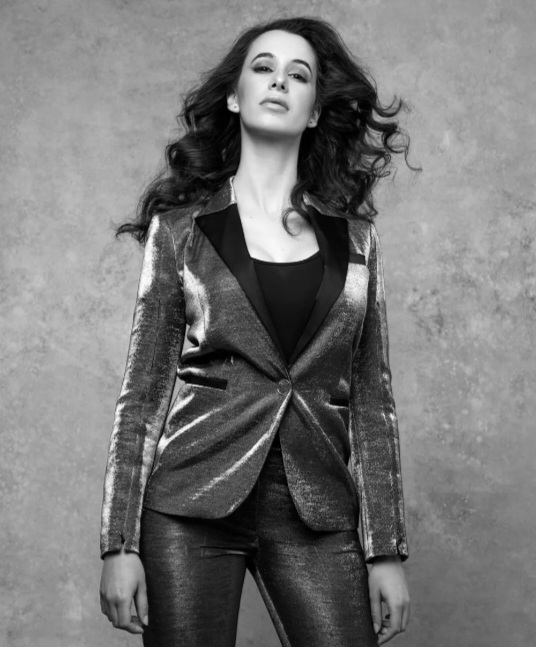
Zoé Mahfouz is an award-winning French actress, content creator, screenwriter, and writer whose work spans fiction, nonfiction, and poetry. She holds a Master’s in Screenwriting from the London Film School and has received international film festival recognition for her comedy screenplays, including at Canadian Screen Award-qualifying events. Her work has appeared in over 90 journals worldwide, with pieces translated and anthologized in Japanese publications, notably Ginyu and The Asahi Shimbun. She is the author of the critically acclaimed, PEN/Robert W. Bingham Prize–nominated ADHD in D Minor (North Meridian Press, 2026), as well as the chapbooks Harper’s Order (Black Sunflowers Poetry Press, 2026) and Borges Must Be Rolling in His Grave (Dancing Girl Press, 2025). Find more information on the Internet Movie Database. And follow her on Tiktok @Lessautesdhumeurdezoe.

