He parks his small white van on the layby. Twisted, wincing, and contorting as he wheezes from the cold. Every now and then a car passes, its headlamps glowering in the lead grey morning, their orange-yellow light passing over the grass of the fields like mini spotlights before disappearing. As if they too, are searching for someone. No one stops. He sees no flashing hazards. He doesn’t look distressed to the other drivers. Probably taking a piss, they think. That’s usually why people stop there. Beyond the heavy metal rail, a vista of flat misshapen grass lays flat with puddles that never change nor evaporate, forever pooled in mud.
He isn’t fooled by the slow glimmers of a pallid sun, nor the silvery frost on the grass that shimmers like fish scales. In the distance, he notes a flank of trees, beeches, cedars and poplars. Despite wildfires on the other side of the world, here he has to turn his collar up to keep the chill out. His coat smells of cigarette smoke, both old and new, so thick and dense is the smell it has become in invisible layer in the fabric. He could leave his van here and disappear into the trees for a while. He is tempted to get swallowed up by nature.
The last he heard, the children were not in England, and he doesn’t know where they are. It’s been eighteen months since he has seen them. The last message he received from their mother was, “Stay away,” and then he was blocked. And try as he might, he could never get through. He wonders where she took them; the only place he can think of is Ireland because her cousin moved there, and Ireland isn’t far, but it is far enough.
His phone rings; he peers at the number. Private number. It’s not her. He would know if it were; he would feel it in his bones, in his padlockedheart. After a few rings he answers and pinches out a bit of fluff that has settled on his tongue.
“Yeah Imran, ‘ello mate, you alright mate? I’ve got a job comin’ up for yer, cash in ‘and. Bit of muscle, ‘eavy liftin. What you sayin?”
“Starting when?” Imran asks. A starling lands directly in front of him on the railing, its feathers mottled with tiny white spots. For a moment he wants to put the phone down and watch the bird, the way she breathes and tilts her head, her alert eyes as she takes in her surroundings.
“Er let me see,” the voice at the other end of the line says. He hears a rustling of paper followed by a loud phlegmy cough. He can’t remember this guy’s name despite having spoken to him several times over the last few months. He’s never met him or seen him and yet his voice feels familiar, like a stranger one sees during the daily commute to work.
“Day after tomorrow, up in Doncaster.”
A fifty mile drive and he has enough petrol.
“Sure,” he says.
“Oh and Imran, make sure you er, save the drinking for after, yeah?”
He hangs up without responding, his liver wincing. He imagines it, sloppy, grey, dull and sickly. He never thought the truth of him would be this.
The world is burning and searing into his consciousness. Worlds upon worlds.
“Hello,” he calls out to no one. The wind chimes back and bristles against his ear.
The van smells like an inside of an old shoe. He fumbles around the back until he finds the flask, rolling around on its side. So that’s what was making the noise at the back as he was driving. The cold metal shocks his fingers as he unscrews the cup and pours black tea into it, stewed, filmy and sour looking.
The blackcurrant-coloured bruise on his wrist throbs and aches all over. He flinches every time something touches it; tender is the flesh, etched on him like an embroidered wound; raw is the stitching. It throbs, and he aches all over. The tea scalds his tongue, but the scorching liquid jolts him into warmth that he feels sail down his oesophagus. Though it is dawn, he eyes the hue of twilight, rimmed with frosted light. Fewer cars pass by.
“Hello,” he calls out into the wind hoarsely.
He is wreckage.
The conker on the ground makes him wonder where the oak trees are. There must be some in the patch of woodland ahead of him, in the distance. He picks it up; it is large, deep brown and he can feel the shine, the burnished, brassy shimmer against the ridges of his gnawed fingernails.
He was lured to this layby before. He recognises it, against all the other laybys in all the other hinterlands that have always threatened to swallow him up whole.
What do they look like now, his children? He does not look at the photos on his phone. The tufts of hair that felt like swollen wool in his fingers, their soft milky smelling skin and the dimples, the strong nose they got from him, the stubbornness too. When things go quiet, when all he can hear is the low whistling of the wind and feel the silence enter his van as he sleeps, he has a deep knowing. They will seek him one day.
He embraces the wild thrill of living nowhere and everywhere, in keeping company with the stars. Talking to the constellations.
He whispers to himself. His is a kind of Godless faith in the divine, a hapless sense of assuredness which he gets from deep within.
The stalks of flowerless flowers remain. The brittle winds and divine golden ripples on the water on a summer’s afternoon. Where the howling of the water comes not from the washing over rocks but from the deep scream out of the earth, into the fire of his heart. He senses a knot in the longing, in the lies he says to himself when he says he is sure he will see them again. The deep ache in his bones does not stir him but keeps him still. The tiredness in his lungs. The dawn breaks into fragments, into shards of silver-white light that heats his gaze and illuminates the hope torn away from him when his spirits are low and his heart is crashing, and the waves in his brain dizzy him, and for a moment he feels that his breath will betray him. Bottles of gin roll around the back; there is whiskey too and rusted metal cups that knock against his belongings, as they thin out and waste away, as his belongings diminish. He is holding on to hope like a chain of gold. He imagines their faces the same and how they are shifting. They both inherited his strong nose and wide forehead. He was a terrible partner but a not so terrible father. He believes.
He is a free man, so to speak but everyone’s freedoms are different. Does he deserve to be angry? Yes and No.
He puts his flask away, closes the back of the van, patting the keys in his pocket to make sure they are still there and climbs over the railing. The grass is flat and cold; patches of sock around his ankle turn wet where his trainers have worn thin. He walks towards the trees, guarding the precious woodland. He sees cans of beer strewn across the muddy patches of grass, empty wrappers, and charred remains of what looks like endless fires. Fire after fire. An old sweatshirt, cigarette buds and an odd sock, wet and soggy with the picture of Donald Duck on it. The further he goes into the woodland, the more the childhood memories seep into his consciousness, his father skinning chickens with calloused hands, fingernails lined with dirt and blood. The hum of the traffic recedes as birdsong and the faraway drilling of a woodpecker force him to look up. Through the canopy of the old oaks and silver birches he can see swathes of sky, its distilled peace tinctured with the caw of crows. Something inside of him loosens, the knot that sometimes feels too tight; he feels the threads fraying; he feels it slacken inside, and he takes a deep breath. Yes, he thinks. Yes. He walks towards a tiny ripple of stream further ahead. The water, the way it washes over the rocks. He inhales its ripples and the damp smell of moss and pine and earthy rituals that whisper and comfort him. As a child he imagined living inside a small cave in a forest, a childish, fairy-tale dream he thought back then. But these dreams come back to him; they linger and exhale their breath on to him and lighten the load. For a moment, the burden lifts and makes him sigh.
“Hello,” he says out loud to no one in particular, but the leaves nearby appear to curl in response and the silence of the air, tempered by the easy flow of the stream makes him feel like the secret passages of his soul have been revealed.
He sits on a log, the rough bumps dig into his buttocks. It feels like he has walked a fair distance, but if he strains his ears, he imagines the odd motorbike or truck hurtling along the dual carriageway. The stream continues to wash over the rocks, and he envisions the silvery scales of fish, though he knows there are no fish here, the water is too shallow. He stands up, his whole body throbbing; he wants the ache to lift. Movement helps, and so he keeps walking; he wants to see how far he can go and whether he can make his way back to the van.
The battery on his phone is draining; he slips it back into his pocket and raises his legs high over the broken logs and trunks that have fallen in storms raged in the past. The sun is breaking out and flooding through the woodland, pouring itself like a stream through the canopy of the trees. He breathes in deeply and inhales the earthy scents that flourish. The fauna and foliage are rich and dense and the light turns streaky as the trees thicken and the woodland becomes denser until he is away from the stream and the traffic in the distance has all but vanished. This would be the perfect place to do mushrooms he thinks, but the thought is fleeting. Here, his skin feels soft, not beaten by the bracing winds out on the open road. Here, he feels like he is being watched over.
He doesn’t know what time of the morning it is. He may find his way back to the van only for it not to be there. He may not even find his way back.
There is a sudden urge to lie on the grass. To look up at the sky to watch the fleeting clouds above drift and sway and fray and fracture and glide above him. The ground is soft under his head, and he feels cushioned by the dense mud with patches of emerald moss.
Dada. He is remembering their first words. The way their skin smelt of comfort and joy and innocence.
He carried them on his shoulders, taking turns until his shoulders ached. Then the cartwheels. “Again! Again!” they exclaimed and then tried to copy him only to tumble clumsily on to the grass.
“I am still their dad. No one can take my place. They are part of me as I am part of them. No one can take my place. No one can replace me.” He repeats this again and again until it is like an incantation that soothes his spirit.
Though the sun has broken through the trees, he feels rain falling, floating in different directions as the wind blows. He thinks nothing of it until his feet are soaking wet and his body starts to shiver.
He turns around.
Surely, he thinks. Surely I just run back the way I came.
And so, he runs. Over the logs, crossing over the stream, the rain dropping into it like pellets; the mud spitting against the backs of his ankles as he becomes breathless. If I just keep going, I’ll end up where I came from, he thinks. Except the more he runs and the more breathless he becomes, the more he senses that he is getting further and further away from the van. He does not, for example, recall seeing the huge cluster of mushrooms and toadstools growing out of the woodland floor. Nor does he remember roots of a towering oak, spilling out, covered in moss, cascading downhill like a mossy waterfall of green velvet. But maybe he just didn’t notice. He stops for breath as the rain continues and now, he is soaked to the bone and the floor is slippery, and there is a smell of dampness like he is stitched into the very groin of the earth.
He wants nothing more than to be in his van now, the heat from the engine warming him, changing into the clothes that are stuffed in a plastic bag that he keeps on the passenger seat. But when he looks ahead, it all looks unfamiliar, and he realises he’s entered something way more vast than he imagined. He strains his ear to listen out for traffic, but the rain is hurtling down fast and he cannot hear anything but the rainfall. Is it raining where they are? He wants a drink. He has half a bottle of Jack Daniels in the back of the van; he wants to feel the burning sensation in this throat, feel his eyes water so that he can blame it on the whiskey. He looks ahead. He has a compass in his van. If only he thought to bring it; and now his phone has died. He has no idea which way is north or which direction he came from. Maybe he will just sit and wait for someone to find him, shrivelled in the rain like skin wrinkled in bath water. Completely soaked, he doesn’t want to stay still and feel his toes slipping around in his socks. He looks around, squinting as his face gets repeatedly and sharply splashed, like receiving a beating from God.
He sees a fallen log; its bumps and the angle of its reclining state seem familiar. He breathes hard and trudges along. Yes, I remember climbing over this. He climbs and squelches in the mud as the rain starts to abate. He trundles on. The children are speaking to him now. “Come and find us,” they are saying. “If not, we will find you.” He hates himself for not being there with them, for being a shit father. Now the wetness on his face is not rain water because it is warm and it is flowing and it is sealing his guilt and sealing in his determination to put things right.
There.
He spots a cluster of catkins dangling and a tall oak with gnarled trunk; he moves towards them. He sees footprints, almost smudged away from the rain but there, nonetheless. He carries on, and now he sees the opening, the vast expanse of grass beyond and the roads in the distance. His van is still there. He is soaked to the bone and shivering now. He fumbles around for his keys and places them in the lock, opens the door and sits inside shivering as he switches the engine on.
I’m home, he thinks.
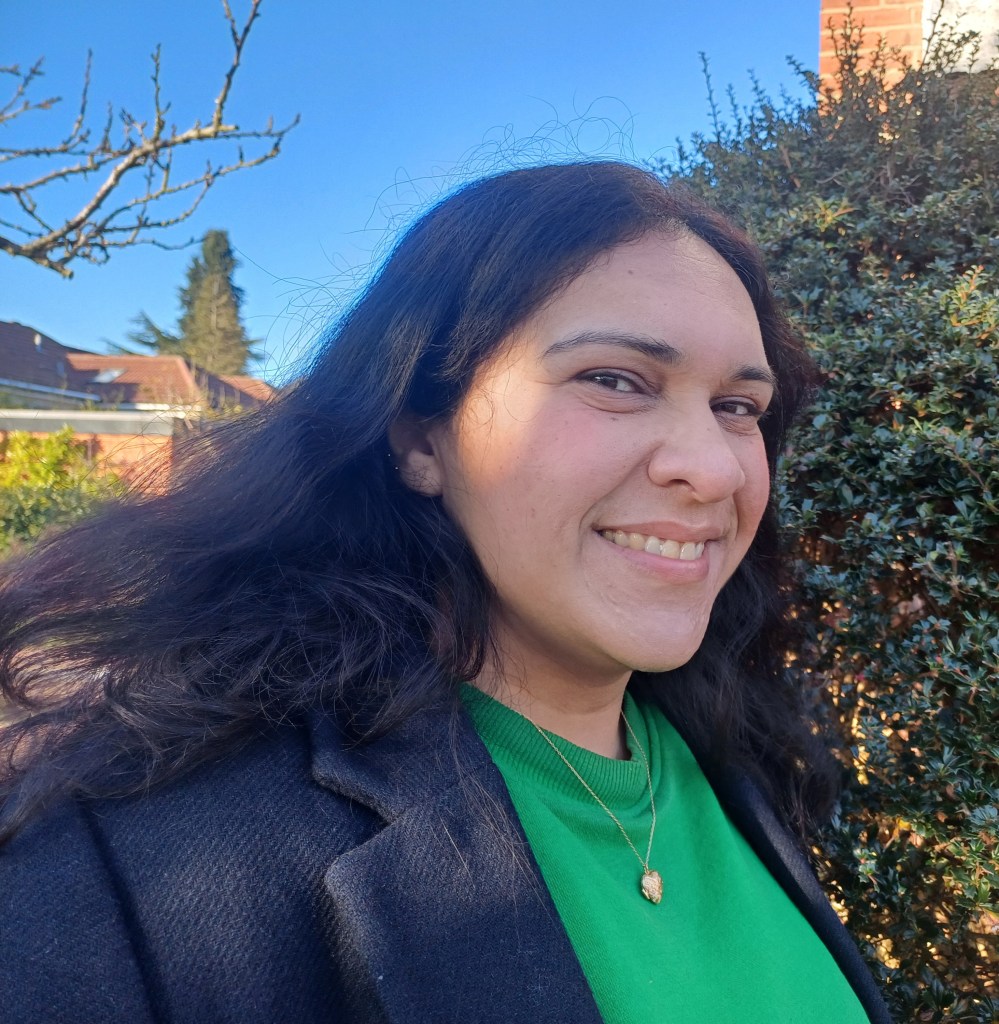
Sophia Khan is writer and teacher based in the UK. She is a member of Rewrite London and has had short stories published in Rewrite Reads. She has been nominated for The Best of the Net in fiction and in 2023 she was longlisted for the Brick Lane Bookshop Short Story Prize. In 2024 she was shortlisted for the London Library Emerging Writers Programme and won silver in fiction for the Creative Future Writers Award. In 2025 she gained a place on the London Writers Award programme. She is currently part of the fiction cohort within the Harper Collins Author Academy.


One response to “The Van”
[…] “The Van” by Sophia Khan […]
LikeLike