When my father was growing up in this village, only donkeys passed through Asgata’s streets. His father, who was the mayor, owned a car, and another villager owned a bus, but those were only used to drive to the city and back. To get to their neighbors’ houses, or church or school, the villagers walked. To transport goods, every household needed a donkey. Field hands would load huge, heavy bags of carobs or olives or wheat onto the animals’ backs, and from the age of ten boys like my father would lead them along the dusty road back to the town square. He tells me that the boys learned to be both patient and headstrong that way, for the donkeys’ proverbial stubbornness would stop them along the way. Sometimes the animals would just stand there for several minutes. Your parents would scold you terribly if you took very long on the road just because the donkey stopped in the middle of the trip and stood still, and you couldn’t coax it to proceed. Just this month, another Greek American woman told me a story of her father getting in trouble as a small child because he took too long guiding a load of olives on the back of a donkey.
Today, there are two donkeys instead of several dozen in this village of five hundred people. Together with the swimming pool filled with water from Cyprus’ new desalinization plant, this stocky brown animal decorates the gardens of a household whose head made a lot of money as a restaurant owner in America. Our other donkey stands droopy-eyed, large-eyed, sad-eyed, neck forever bent low, nibbling at weeds, and fur always dirty, a relic of the old life among the carob trees, which generations of mice have eaten hollow. They bray at intervals, especially it seems when you are trying to read a newspaper, in spats of five or six urgent raspy groans that echo in your ears for another paragraph or two.
Silence in Asgata comes when you least expect it and can last so long you think it will last forever, and you sit down to take advantage of it by writing a few lines or thinking about that decision you’ve been putting off. A rooster usually interrupts it, though, and it is a myth that roosters crow at dawn. Once one crows another dozen start, usually at three in the morning when your friends have gone home after the DVD and wine are over, and you want to get to sleep at once so that the next morning at work your colleagues won’t point out dark circles under your eyes.
Though rooster-crowing is annoying when you’re trying to fall asleep, it will hardly wake you up. The dogs in Asgata, on the other hand, are numerous and loud enough to waken my half-deaf aunts and if their yapping were to extend much past midnight, I think I’d move to the city. I’m thankful that the dogs sleep at night.
Like their egg-laying poultry, the Cypriots’ yappy dogs are kept for the service they provide. Most villagers in the early twentieth century then couldn’t afford a gun, and the delicacies of game birds have only recently reached the masses. Twenty-five percent of all Cypriot men today have a hunting license, gun and usually a few hunting dogs. Hunting season only lasts for a few months, and during that time the “hunters” leave home before dawn on Wednesdays and Sundays to shoot turtle doves, thrushes, woodcocks, quail, and, for just a few weeks, hares and partridges. My mother, who is American, corrects my brother and me when we talk about friends of ours who are hunters, since Cyprus hasn’t got any animals large enough to hunt, and their sport is only “bird-shooting.”
We got one of these “hunting” dogs as a gift once, when my brother was twelve and I was seventeen. Dino had always wanted to go hunting with his friends and their fathers, but my parents said no, and the dog was a sort of compensation. In spite of Dino’s efforts to train the dog, it acted like it thought it was human and would tear down the laundry as if to help with the chores, since we didn’t make use of him on any hunting. He nibbled around in the weeds all day, intent on tasting the poison left for mice and rats, and before even my parents were quite tired of him, this our only pet began to drool heavily one afternoon, until he crumpled under the weight of his own bones, and the next morning before school Dino buried him in a field near the house.
It seems we want a use for all our animals; somebody else’s pet cats (they might be stray, but all seven or eight of them look too healthy for the name) forage around our yard and we gave them food until we found that snakes appear when the cats get fed. When we throw our leftovers in the rubbish and seal the cans so cats can’t climb in, they are forced to supplement their diet with lizards, mice and the few snakes that threaten our yard. Since they protect the yard, I’ll suffer through their irritating racket as they mate and I’ll put up with the way they rub their ribs against my ankles during outside meals. I can’t complain about the roosters crowing and the dogs howling if they give us eggs and retrieve our birds.
Yet for all the uses to which Asgata puts its animals today, we could get eggs at the supermarket along with Heinz ketchup, Hellman’s mayonnaise and canned bamboo if we wanted. Animals are a luxury and a hazard; the rich man’s donkey got loose one night and strayed into the road which has no streetlights, and at two in the morning Dino drove into it with my car, crumpling part of the hood and side and shattering my windshield. I tell the story as a joke, now that I’ve fixed the car, and people tell me their animal horror stories: one man had a sheep jump onto his hood as he drove down the service road along the highway.
Only old men herd sheep and goats, and it’s really the retired women that raise chickens. Like me, they find it strange that people have started to keep animals around the house just for company, much less inside the house. They’d rather keep the streets narrow, the houses close together in spite of how easily our cars get scraped on the wall as we round bends and try to squeeze past one another if two drivers confront one another traveling in opposite directions. If you don’t want to scratch your car, someone needs to back up a little, change their course.
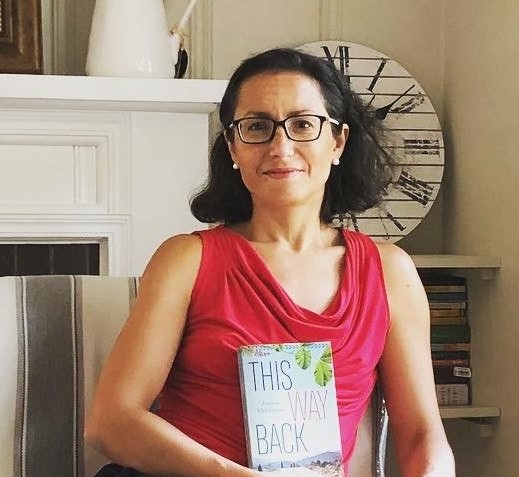
Joanna Eleftheriou is author of This Way Back, a collection of essays on growing up and coming out on the island of Cyprus. Her scholarship, essays, poems, and translations have appeared in Crab Orchard Review, Arts & Letters, Bellingham Review, and Sweeter Voices Still: An LGBTQ Anthology from Middle America. A contributing editor at Assay: A Journal of Nonfiction Studies, and reviews editor at Ergon: Greek/American Diaspora Arts & Letters, Joanna teaches at Christopher Newport University and the Writing Workshops in Greece. Find her at JoannaEleftheriou.com. And on Instagram and Twitter/X @joannaessayist.

