The sun has set on Santa Barbara
and offshore oil rigs at the horizon
are lit up like a row of Christmas trees,
each platform out there mining the seabed
for countless giga-Joules of energy.
Below them, marine life tries to survive,
though tankers threaten whales’ safe passage:
too many of their giant carcasses –
crushed by hull, disfigured by propellor –
have fallen to the deep or washed on land.
Even so, petrels dart among the waves.
Murres dive where anchovies group near the surface.
Sea lions pick starfish off the pilings.
Fathoms down, sharks rove and crabs meander.
Squid luminesce with brilliant trickery.
Hagfish scavenge dead whales at the bottom.
From under the silt, crude oil siphoned up
powers commerce, holiday travel, sport.
To say the ocean is agnostic to this
would be untrue. No, whales are patient
until the day when those rigs and tankers
crumble, capsize, then sink to the abyss –
becoming, perhaps, new habitats
for octopus, anemone, oyster.
In the fullness of time, centuries later,
waters again will roil with their great bodies:
their feeding, their mating, their migrations.
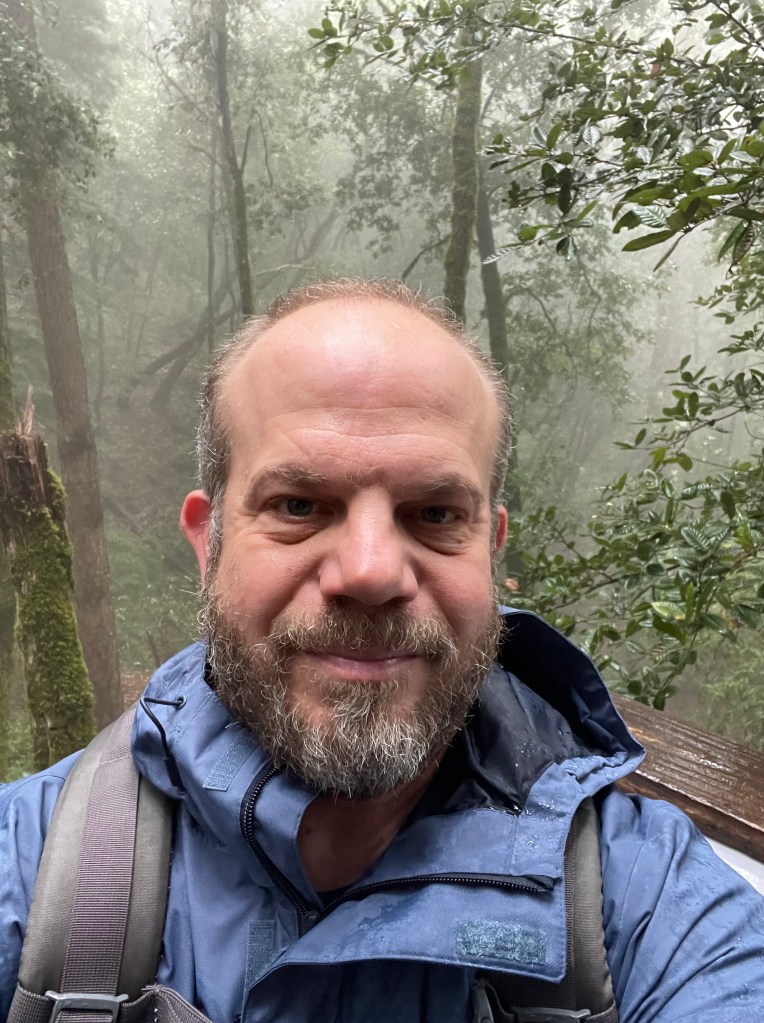
Jason Harlow is an engineer living with his wife and son in Menlo Park, California. The son of a pianist and an English teacher, he grew up in a Vermont village, studied classical music in Baltimore, then worked in Boston before making a home in the Bay Area. His poems have been published by California Quarterly, Onion River Review, and Humana Obscura. You can find him on Instagram at jason_m_harlow and on Bluesky at jmharlow.

