As soon as I was born, I cried, swallowed and burped, which mom expected. She had birthed two kids before me. What baffled her, as she said, was my smile under the warm yellow bulb every time electricity supply was restored and my fuss when shielded from it. Hence, she was embarrassed that the next thing I babbled after “Dada” and “Mama” was “Up NEPA” — the most important chant in Nigerian homes after “Jesus, Allah” and “money.” She was sad that I knew the epileptic power supply in Nigeria in my first year of living.
Mom and Dad were petty traders when we lived on the first floor of Presidential Lodge in a college community.
Soon, I registered people’s reaction at the mention of “Nigeria” and sighed every time it was mentioned, though I didn’t know why.
When I grew up, I realized there was nothing “Presidential” about our apartment. It was the first three-story in the community, and nothing more. The landlord’s children fought each other for their inheritance, while my siblings and I filled our hair with sand. We wore oversized clotheswhich we were expected to grow into. Perhaps, from learning to live with our clothing, we would learn to live with the discomforts of Nigeria.
One evening, while sipping Guinness stout, Dad told me how he met Mom, while working in a factory in northern Nigeria. Emphasizing her devotion to him when he sustained injuries, because the factory refused to pay for it.
“Our love started in the hospital ward,” Dad said. “With her support, I quit my job and opened a patent medicine store.”
It was then I realized Mom had not always been a petty trader.
“She was an auxiliary nurse and taught me how to dispense drugs. I also referenced Where There Is No Doctor, while attending to customers.”
“So why did you relocate to the east?” I asked.
Dad gulped his drink and took a deep breath. What he wanted to say was heavy and needed diluting. “We left because of the riots. It wasn’t our first experience, but we knew it was time to leave Zaria when we became targets. Same thing happened to our fathers and mothers during the Nigerian/Biafra war.”
Later that evening, Mom whispered the riots started as a religious skirmish before they turned tribal. “Now eat your food,” she said.
I knew it was all she’d say about it.
In school, I was excited that I’d learn about the riots and the war and the reason everyone frowned when they talked about Nigeria — until our teacher asked why I was curious about death instead of happy things like other kids. I had no answer and felt ashamed.
Instead of history, our teacher taught us social studies, beginning with “family” which she said was the most important unit of society.
The father was the head, the mother, his assistant, and the children were to obey, no matter what. Because Jesus loves children who obey.
She taught us tolerance. I wondered if it was what we needed to survive. She told us not to steal; but we came to school with our own seats and cramped ourselves in a classroom with broken windows and leaking roofs. I wonder who stole the money meant for our school.
I did not learn history throughout primary school, and by the time I graduated, history had been removed as a subject from the Nigerian school curriculum.
When I asked in secondary school, the teacher answered, “You should be grateful we don’t have rampant school shootings in our country. In America, students become history in classrooms.”
I made excellent grades in social studies and civic education, which meant I knew what my teachers wanted me to know and lacked the knowledge hidden from me.
Thus, one year after moving to the US, land of the free, when I read that some courses had been defunded, reclassified, and scrapped, it became oddly familiar.
On December 13, 2025, while speaking with a friend in Nigeria, the electricity supply was restored in her neighborhood, and she screamed, “Up NEPA!” Even though the National Electric Power Authority (N.E.P.A) was replaced by P.H.C.N and later privatized, erratic power supply persists.
That same night, while walking downtown in Flagstaff, Arizona, I read on CNN about a school shooting at Brown University, bringing the total to 75 shootings for 2025.
Years have passed, yet things remain the same.
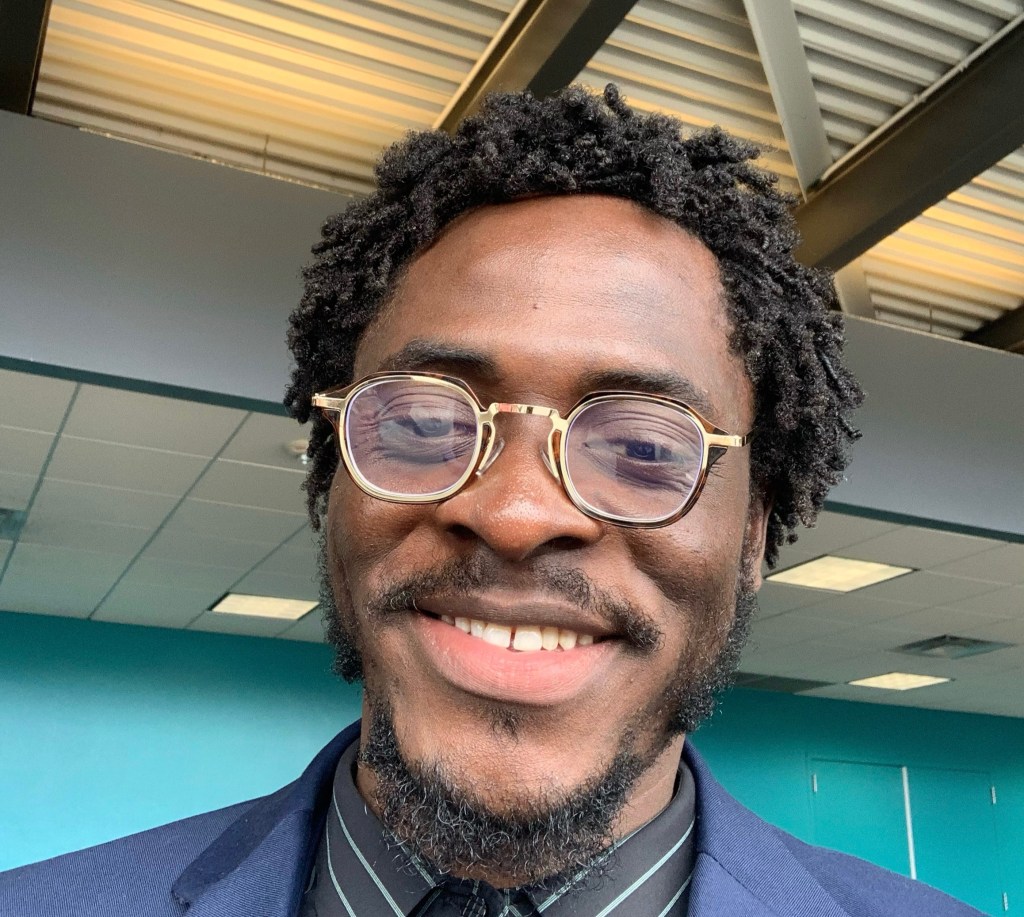
Augustine Obasi (he/him) is a Nigerian writer. He has an MFA in Creative Writing from Northern Arizona University where he served as fiction editor of Thin Air Magazine. He will be starting his PhD in the Fall at University of Georgia. His work has been published at Spellbinder Magazine and is forthcoming at The Carolina Quarterly and Fahmidan Journal. You can reach him on Instagram @Auggiefilms and on Twitter/X @Auggiefilms.

