Jackboots and helmets demarcate us and freedom.
Plus in binoculars, multiply with machine guns, divide by
bows and arrows and the ever ubiquitous police dogs
who growl yellow teeth, salivate for captured flesh and the
sum equals a walled city, a concentration camp. Here
inmates are ducks, our destiny lies with a hunter’s
loaded gun. Daily we watch killers bump up and down in
armoured cars, aware that they will shoot should rebels
venture near the line. Sometimes we hear noises and
sometimes we see the incidental plume, tall, beautiful,
shaped like a chute and particles, falling poetically to
earth and we know that that is another victim gone.
Always we see stuff, always stuff moves up and down,
stuff we can’t see but which we suspect to be solids and
liquids, diodes you can connect and koboom goes the earth.
Then there are the trucks, laden with fruits and vegetables
and always trucking out and never in and we wonder why
oppressors can sit under trees and munch on dates
while natives grow thin in the legs and fat round the belly.
The kingdom of man suffereth violence and men of violence
take it and blessed are the weak, for they shall be decimated.
The border is where you come when you are done with running,
when all you want is to sneak among the crowd, read your
obituary, find out how you died—fast, or slow, alone or with
neighbours calling your name, uninjured or bleeding from your
head while shrapnel fell and bulldozers shifted bricks and
concrete. The border: a net, spun by a spider, cast by a crab,
dragged by a shark while fish fumble and flounder. The border:
Ukraine, Gaza, Bịafra, Mexico, Armenia, Rafah—
you, me, the hunger, anger, blood, bile, cold, sweat…
The border: a flock of queleas when at dawn they
cloud the neems and jacarandas.
I Wake with the Intention to Show You Beauty
(for Obianuju)
but instead death strikes in the form of a falcon,
this dawn of a harmattan season when doves
preen overnight feathers, coo into the cool
of sunless clouds—the move so quick, so precise
it drowns my happiness, cuts short my laughter.
I watch talons lift, head toward the rocks and the
lifting of claws is the lifting of pages of a book I
closed last night for the final time. Or so I thought.
Memory beckons me, grief draws me to the dance floor,
I waltz with tribes, waltz with rifles and machetes, spin
till I become drunk on a war and the chaos it left in bodies
of a tribe. Here is the bitter truth: in the game of survival
we give or take all. Beta anụ bụ n’aru nama. Here
is the music that keeps all nature grooving: the
python tests his muscles on the bush pig and the deer.
A pebble, placed in a catapult, shot aimlessly
cannot save a dove, carried high into the clouds.
I would not have pointed at birds had I known a
quest for beauty would translate into a lesson on blood
and how it can stain our best day…Come, nkeọma,
return to the room and to mama. Playthings there are
more rewarding than watching death display his wildest
skills. A father has nothing to return to than a book I
closed last night, its commas and comas. That is the balm I rub,
drug I drink. That is where I fish for answers, angle for
clues to help me crack the code of country, history, memory.
Help me make sense of mornings such as this.
I Told You You Would Win a Jackpot
(for Bosede, for Akunnia)
I remember vaguely, not photographically or diagramatically.
(Nowadays I remember in grey and burnt umber,
in ultramarine and periwinkle blue). I remember he said:
this is your sister and left a boy to unmorse the code.
I remember a room and you, stretched on a bamboo bed.
A crow sauntered across your cheek and a canary
crooned into your voice at the joy of seeing the bone
of your bone. I remember that despite the
needle sticking from your wound we talked and laughed
ever after. Your fascination with uniforms and boots
matched my fascination with rifles and mortars.
His fascination with weapons and their makers
canceled our fascination with a world,
spinning in a space choked with gasses.
I remember that shortly after the doctors
laid down their tools in surrender to the power of poison.
I remember the last scene: it was in my room and
he sat on a chair, cried bowl, after bowl, after
desalinated bowl. I remember I looked on:
was it with a brow of bricks, a heart of stones?
I remember the trip to Ihiala, green leaves
stuck in the front and rear, mourners mouthing
onye o’melu dibe while a giant popped chocolate bars
into his mouth: the giant being earth, chocolate,
what remains of earth. I remember you. I remember him.
I remember the current that swept you away,
remember the isle where it deposited you, a place
you wrote to say is the epitome of cool,
rifles do not bloom and the words stroke and poison
do not belong in your idiolect.
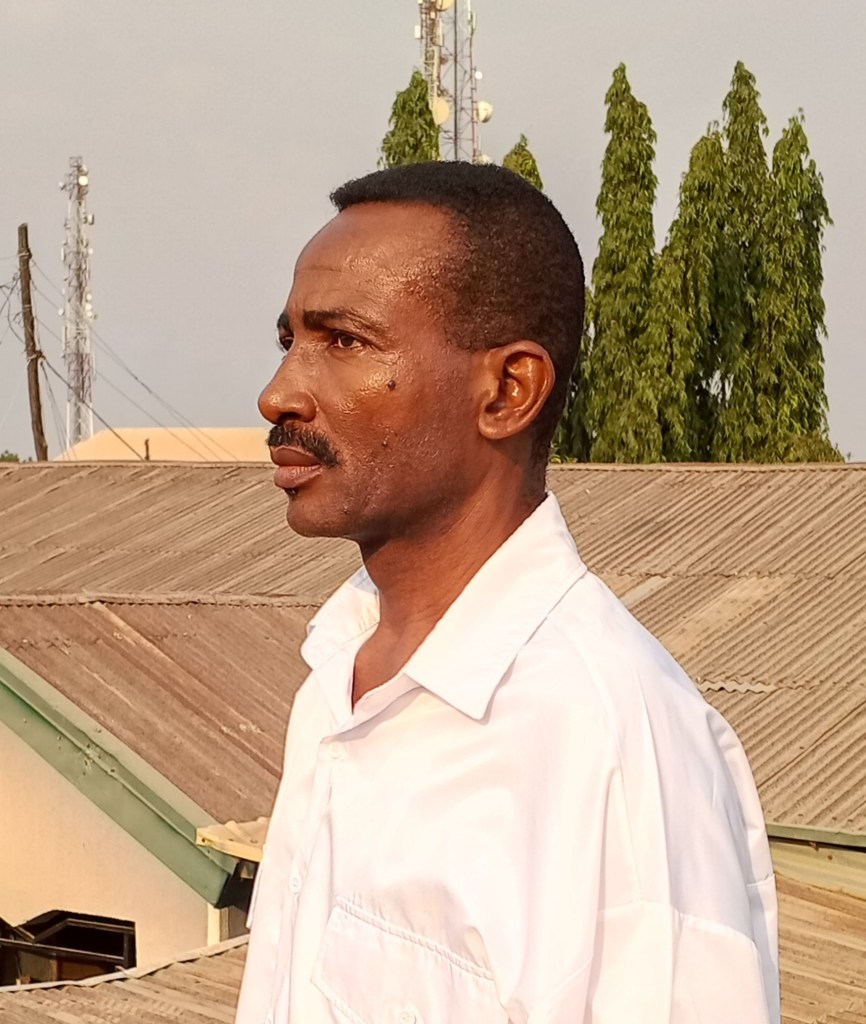
Victor Osemeka is a Nigerian of Igbo extraction. His poems explore the spaces between man versus man, man versus nature and man versus divinity. Aside from writing, he draws and paints. He has work published or forthcoming in Brittle Paper, African Writer, Morning Star UK, The Marrow International Poetry Australia and Consequence Forum. Find him on Facebook @Victor Osemeka, on X @Osemeka1123V and Instagram @victorchukwu645.
 the Decolonial Passage