When the flooding starts, and the rich flock to
their yachts, the rest of us will inherit the beach-front views
only to climb up trees and whine at God—but you promised!
And God, starting his Prius, shouts back something about carbon
footprints: his but the size of a seraphim’s, ours lug-soled
and everywhere, even the damn Moon.
And that will be that; we’ll re-draw the maps and
eat more fish. Eventually, tired of tuna, the yachts
become rockets, sailing through the thickened atmosphere.
When the terraforming starts, wheat will be the first to fail;
the last will be rice, abandoned in the smaller craters.
In the end, palm trees will populate the Moon.
It makes sense, the Moon having everything they need:
sandy dirt, unfiltered sunlight, and islands, which,
in the absence of liquid water, deliver the seas
and wide-open shores palmeras crave, deep in their green hearts.
If the Antilles can hook-and-crook the Caribbean from the Atlantic,
surely Tranquility can be found cleaving to its own islands:
the wreck of the Ranger; the breezeless flag; the sunken
heel of a tall boot…indeed, palm trees were made for the Moon.
Too frugal now for fire, the rich will scrap their ships by hand,
committing to this one last colonial undertaking.
Foundations will be dug, small houses hammered out
and thatched over, all beneath great glass domes and the future.
Back on Earth, most of us will be dead, but hey—we got a
brand new Moon, which, as always, watches, spinning
its gears against gravity, the tempo of the spheres.
The palm trees, in their understanding, try to show the Moon
what comes next. It’s one thing to be a fixed point in an idea
of the sky, eclipsed at a distance by the transit of catastrophe—
it’s another thing entirely to brace against a heaving chest, carrying,
not by choice, the shadow puppets of fire and smoothbore bullets.
But matches are rationed now, posing too great a risk to the domes,
guns a laughable waste of precious metal. Yes,
World War Moon will be fought with sticks and stones and
coconuts. And the domes will hold up marvelously.
And when the Moon spins on, with no one left to inherit the shade,
maybe the few of us on Earth will look up and whisper blessed be
the palm trees, for theirs is the kingdom of Heaven — or, at least, good night.
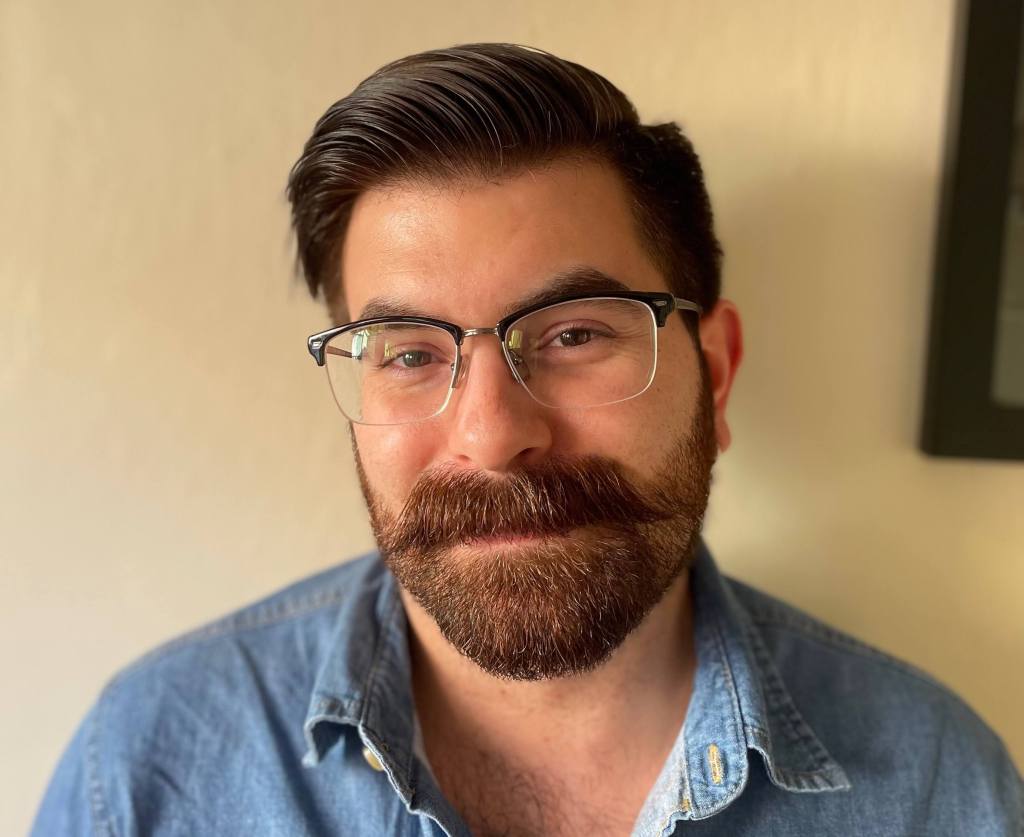
Jesse Gabriel González is a poet from the great state of New Jersey. He holds an MFA from the University of Oregon and a BA from Cornell University. He was the recipient of a Contributor Award from Bread Loaf and an Anaphora Arts fellowship. His poetry appears in The Seventh Wave. He serves as an Editorial Assistant for Poetry Northwest.
 the Decolonial Passage